
Cement mortar is one of the most widely used materials in the construction industry. It is commonly used for masonry, plastering, tile installation, and repair work. Although traditional cement mortar provides adequate strength, it often suffers from several practical problems during construction and service life.
Common issues include poor workability, insufficient bonding strength, and a tendency to crack after hardening. These problems become even more noticeable when fine sand or special aggregates are used.
To address these challenges, modern dry mix mortar formulations often include functional additives. Among them, redispersible polymer powder (RDP) is one of the most effective materials used to improve mortar performance.
By adding redispersible polymer powder, mortar can achieve better flexibility, stronger adhesion, and improved crack resistance. In this article, we explain how RDP works in cement mortar and why it has become an essential component in modern construction materials.
What Is Redispersible Polymer Powder?
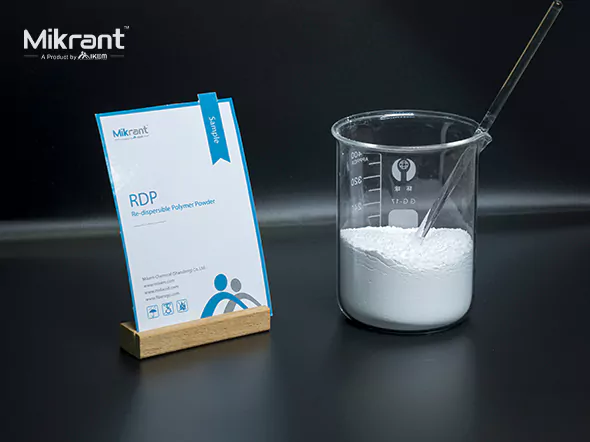
Redispersible polymer powder is a free-flowing powder produced by spray drying polymer emulsions. When mixed with water, it can redisperse into stable polymer particles, similar to the original latex emulsion.
In dry mix mortar production, the powder is blended with cement, sand, and other additives. Once water is added during mixing, the powder disperses throughout the mortar mixture.
As the cement hydrates and the mortar begins to harden, these polymer particles gradually form a continuous polymer film inside the mortar structure. This film bonds with cement hydration products and aggregates, creating a stronger and more flexible internal structure.
In simple terms, redispersible polymer powder acts like a flexible binder within the mortar, helping the material perform better under stress.
Why Traditional Cement Mortar Often Cracks
Although cement mortar has good compressive strength, it is inherently brittle. Several factors can lead to cracking or performance issues.
Drying Shrinkage
During the curing process, water gradually evaporates from the mortar. This causes shrinkage, which can lead to internal stress and eventually cracking.
Poor Workability
Without proper additives, mortar may feel stiff and difficult to apply. Poor workability can lead to uneven application and construction defects.
Limited Adhesion
In applications such as tile adhesives or repair mortars, traditional mortar may not provide sufficient bonding strength.
Use of Fine Sand
In many regions, very fine sand must be used due to resource availability. Fine sand often increases water demand, which can worsen shrinkage and cracking problems.
Because of these limitations, additives like redispersible polymer powder are widely used to improve mortar performance.
Key Benefits of Redispersible Polymer Powder in Mortar
1. Improved Workability
One of the first noticeable benefits of adding redispersible polymer powder is better workability.
During mixing, the polymer particles help disperse the mortar components more evenly. In addition, RDP introduces tiny, evenly distributed air bubbles into the mortar system.
These micro air bubbles improve the flow and consistency of fresh mortar, making it easier to mix, spread, and apply.
As a result, mortar containing RDP typically offers:
- smoother application
- improved consistency
- easier handling during construction
This improvement can significantly enhance construction efficiency.
2. Increased Flexibility
Traditional cement mortar is strong but rigid. When subjected to stress, it tends to crack rather than deform.
Redispersible polymer powder changes this behavior. As the polymer film forms inside the mortar, it creates a flexible network that connects cement hydration products and aggregates.
This structure allows the mortar to absorb small movements or stresses without cracking.
Because of this increased flexibility, polymer-modified mortar can better resist mechanical stress, temperature changes, and substrate movement.
3. Better Crack Resistance
Cracking is one of the most common durability issues in cement-based materials.
Redispersible polymer powder helps reduce cracking through several mechanisms.
First, the small air bubbles introduced by RDP can help relieve internal stress within the mortar.
Second, the polymer film acts as a micro crack-bridging material. When small cracks begin to form, the flexible polymer film can slow or stop their growth.
In addition, polymer materials can absorb energy during crack propagation, which further improves crack resistance.
These effects make RDP particularly valuable in applications such as exterior wall mortars and tile adhesives.
4. Enhanced Bonding Strength
Adhesion is critical for many mortar applications, including tile installation, repair mortars, and insulation systems.
Redispersible polymer powder improves bonding strength by forming a flexible bonding layer between the mortar and the substrate.
This polymer film increases the contact area and improves adhesion to various surfaces, including concrete, masonry, and tiles.
As a result, polymer-modified mortars generally provide stronger and more reliable bonding performance.
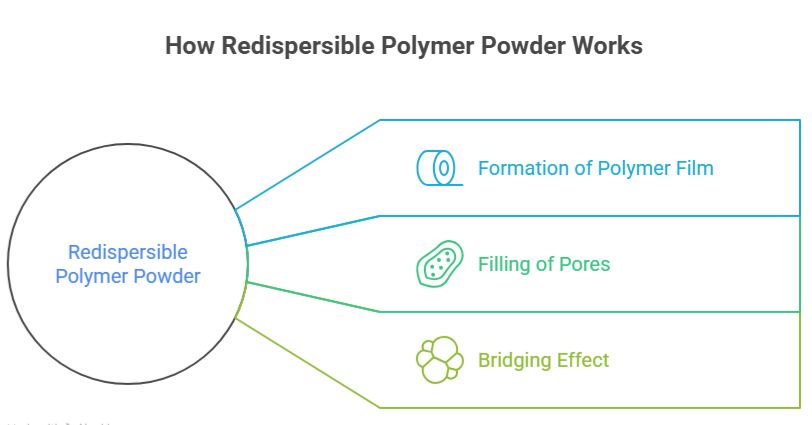
How Redispersible Polymer Powder Works
At the microscopic level, redispersible polymer powder modifies mortar through several structural mechanisms.
Formation of Polymer Film
During curing, polymer particles coalesce to form a continuous film that covers cement hydration products.
Filling of Pores
The polymer phase partially fills pores within the mortar structure, helping improve cohesion and durability.
Bridging Effect
Polymer films can connect adjacent particles and fill micro cracks, forming a bridging structure that increases flexibility and toughness.
Together, these effects significantly improve the overall performance of cement mortar.
Typical Applications of Redispersible Polymer Powder
Because of its performance benefits, redispersible polymer powder is widely used in many types of dry mix mortar, including:
- tile adhesive
- exterior insulation system mortar
- rendering mortar
- repair mortar
- self-leveling compounds
In these applications, RDP helps provide the balance between strength, flexibility, and adhesion that modern construction materials require.
Frequently Asked Questions (FAQ)
What does redispersible polymer powder do in mortar?
Redispersible polymer powder improves mortar performance by increasing flexibility, enhancing adhesion, improving workability, and reducing the risk of cracking.
Why is polymer used in dry mix mortar?
Polymer additives help overcome the brittleness of traditional cement mortar. They create a flexible internal structure that improves durability and bonding strength.
Is redispersible polymer powder necessary for tile adhesive?
Yes. In most modern tile adhesive formulations, redispersible polymer powder is essential because it significantly improves adhesion and flexibility.
Does polymer powder reduce mortar strength?
Polymer modification may slightly affect compressive strength, but it greatly improves flexibility and bonding strength, which are often more important for real construction performance.
Conclusion
As construction technology continues to advance, traditional cement mortars are gradually being replaced by high-performance dry mix mortars.
Redispersible polymer powder plays a crucial role in this transition by improving several key properties of cement-based materials.
Due to its excellent modifying effects, redispersible polymer powder is widely used in various dry-mix mortar products, such as:
- improved workability
- higher flexibility
- better crack resistance
- stronger bonding strength
- enhanced durability
For these reasons, redispersible polymer powder has become an essential ingredient in modern construction materials and dry mix mortar systems.
