

Cement-based self-leveling mortar is widely used in modern flooring systems due to its excellent flatness, fast installation, and reduced labor requirements. It is commonly applied in residential buildings, commercial spaces, hospitals, offices, and industrial floors.
However, compared with conventional mortars, self-leveling mortar places much higher demands on material performance, especially on chemical admixtures. In many real projects, problems such as unstable flowability, surface bubbles, segregation, slow strength development, or cracking are not caused by cement itself, but by improper selection or use of superplasticizers.
In recent years, polycarboxylate superplasticizer (PCE) has become the preferred choice for cement-based self-leveling mortar. This article explains why PCE is particularly suitable, how it works, and what should be considered when using it in practical formulations.
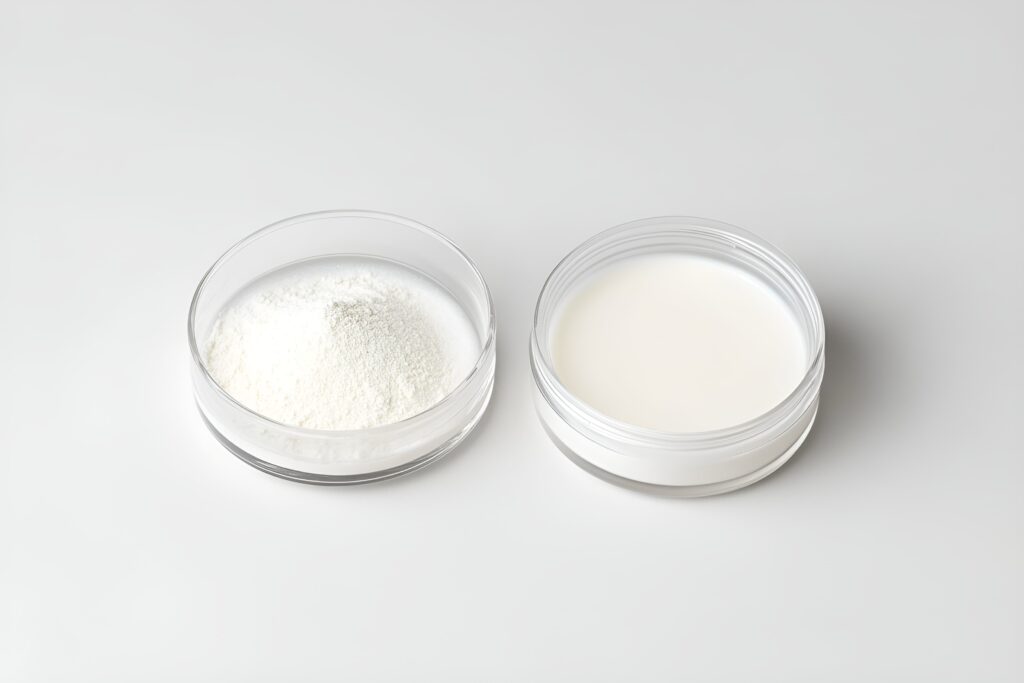
Self-leveling mortar is designed to flow and level under its own weight without vibration or extensive manual finishing. To achieve this, the material must meet several demanding requirements at the same time.
“High flowability” is the most basic requirement of self-leveling mortar. However, high flow alone is not enough:
Therefore, self-leveling mortar requires high flowability with strong resistance to bleeding and segregation, which is difficult to achieve with conventional admixtures.
During application, self-leveling mortar needs sufficient working time for mixing, pouring, spreading, and deaeration. At the same time, the floor often needs to:
Traditional approaches often involve extending working time with retarders and compensating for strength loss with accelerators.
However, this method tends to complicate formulations, reduce batch-to-batch consistency, and compromise adaptability to different cement types.
This creates a contradiction between retardation and early strength development, which must be carefully balanced.
In most projects, self-leveling mortar is applied as a thin layer and often under non-ideal curing conditions. Excessive drying shrinkage may lead to:
This is also one of the most common sources of quality complaints for self-leveling materials. Therefore, reducing shrinkage is critical for long-term performance and customer satisfaction.
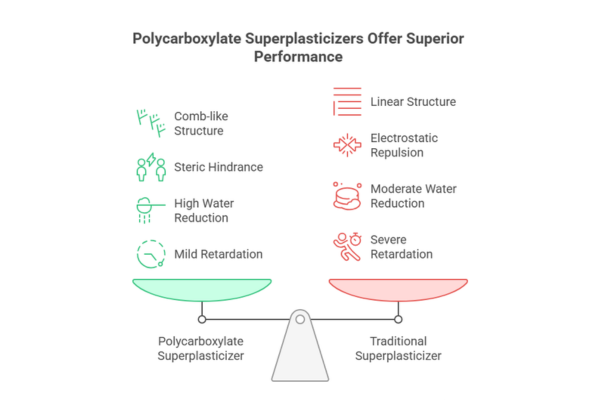
Polycarboxylate superplasticizer differs fundamentally from traditional superplasticizers (such as naphthalene- or melamine-based types) in both molecular structure and working mechanism.
Polycarboxylate superplasticizers work differently from traditional types such as naphthalene- or melamine-based products. Their comb-like molecular shape helps keep cement particles separated, so they do not stick back together. In simple terms, they stop the particles from sticking back together after mixing.
This allows the mixture to flow smoothly with less water and keeps the flow stable over time, which helps to:
This is especially helpful for self-leveling mortar, where smooth and stable flow is critical.
Some traditional superplasticizers achieve water reduction by strongly slowing down cement hydration, which can negatively affect early strength.
Polycarboxylate superplasticizers are different. They reduce water efficiently without greatly slowing down cement hardening. This means less need for extra retarders, better early strength, and a simpler, more stable formulation.
This allows formulators to:
For self-leveling mortar manufacturers, this means more consistent performance and easier quality control, especially in large-scale production.
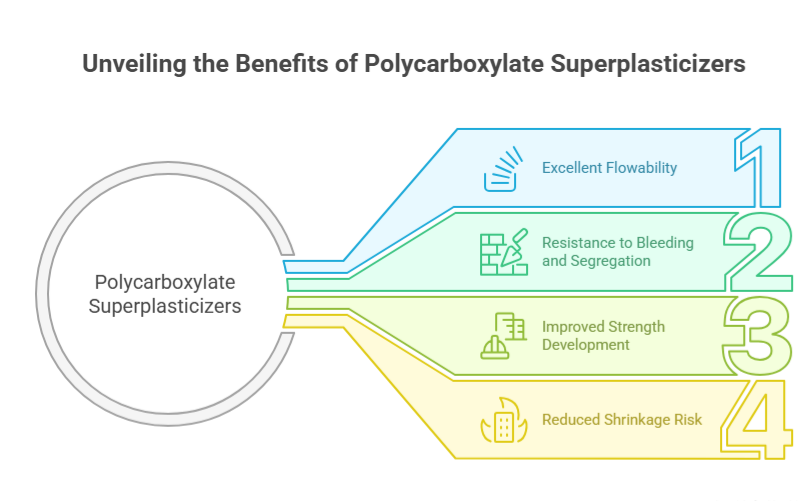
Polycarboxylate superplasticizers are very efficient at dispersing cement particles, which means they can deliver excellent flowability even at low dosage. Self-leveling mortar can easily reach the required flow level while staying uniform and easy to control. This improves material efficiency, helps keep costs under control, and makes it easier to maintain consistent quality from batch to batch.
Thanks to stable dispersion and mild air-entraining characteristics, polycarboxylate-based systems perform well in preventing bleeding and particle separation. Fine materials stay evenly suspended, resulting in a smoother and more uniform surface. This stability is especially important for thin, high-flow self-leveling layers, where defects are easy to see and hard to fix.
By reducing the water-to-binder ratio and improving particle packing, polycarboxylate superplasticizers contribute to:
This supports faster construction schedules and earlier floor covering installation, which is highly valued in commercial projects.
Using less water leads to a denser internal structure and less drying shrinkage. In many self-leveling systems, this helps the mortar stay in a low-shrinkage or slightly expansive condition. As a result, the risk of cracking is reduced, even when curing conditions are limited or not ideal.
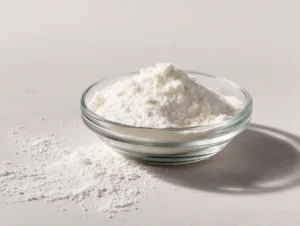
For cement-based self-leveling mortar, powder-form polycarboxylate superplasticizer is particularly suitable.
Key advantages include:
Different powder PCE products may vary in:
Therefore, selecting the right grade is essential for achieving optimal performance.
One important characteristic of polycarboxylate superplasticizers is their air-entraining tendency.
A moderate amount of entrained air can:
This is beneficial during mixing and pouring.
For self-leveling mortar used as a final decorative surface, excessive air may cause:
To control this, formulators typically:
With proper formulation design, surface defects can be effectively minimized.
If you are producing or purchasing materials for:
Polycarboxylate superplasticizer is generally the most reliable and future-proof choice.
Key benefits include:
From both technical and commercial perspectives, PCE-based systems help reduce quality risks and improve product competitiveness.
The value of polycarboxylate superplasticizer in self-leveling mortar is not limited to high water reduction. Its real advantage lies in helping formulators achieve a balanced system that combines flowability, stability, strength development, and durability.
When properly selected and formulated, polycarboxylate superplasticizer significantly enhances the reliability and performance of cement-based self-leveling mortar, making it the preferred solution for modern flooring applications.


MIKEM is a global manufacturer and supplier of specialty chemical products. We are committed to becoming your preferred partner in specialty chemicals with our competitive product portfolio, strong R&D capabilities, and professional formulation expertise .
How Redispersible Polymer Powder Improves Cement Mortar Performance Cement mortar is one of the most widely used materials in the construction industry. It is