
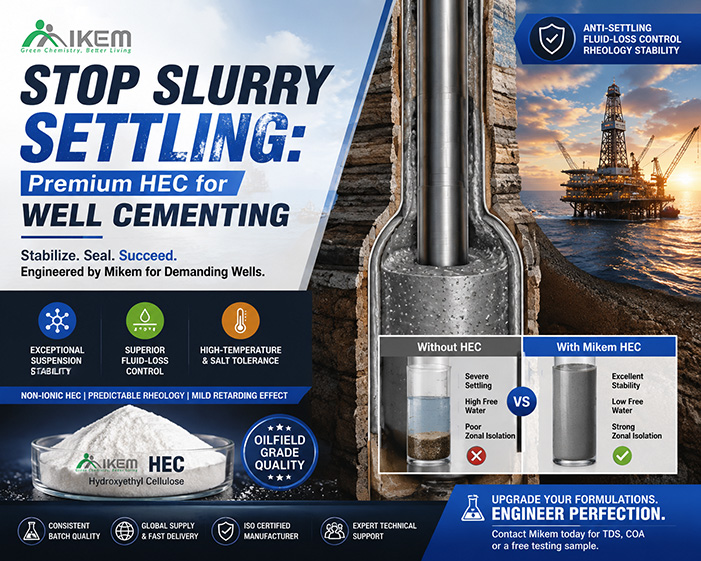
In the demanding landscape of deep-water and depleted-reservoir drilling, low-density cement slurry systems are critical for preventing lost circulation in fragile, low-pressure formations. However, petroleum engineers and formulation scientists consistently face a severe technical bottleneck: the inherently high water-to-cement ratios and low solids content of these slurries inevitably lead to poor settling stability and excessive free fluid generation. These issues don’t just compromise zonal isolation—they risk catastrophic cementing failures.
Enter Hydroxyethyl Cellulose (HEC). As a premium non-ionic water-soluble polymer, HEC has proven to be the ultimate anti-settling and fluid-loss control additive. At Mikem, a leading chemical manufacturer specializing in high-performance cellulose ethers, we have engineered oilfield-grade HEC solutions designed specifically to tackle the extreme rheological challenges of modern well cementing. By stabilizing lightweight slurries, our HEC ensures flawless annular sealing and operational safety.
The Root Cause of Settling in Low-Density Cementing
Understanding the physical mechanics of slurry failure is the first step toward preventing it. The settling instability in low-density systems is an inherent contradiction in traditional formulation design. To achieve target low densities, formulators rely on elevated water volumes and lightweight extenders like cenospheres or microsilica. This drastic reduction in the solid volume fraction creates a highly unstable liquid phase.
Under downhole gravitational forces, a devastating “stratification” occurs:
- Heavy Particle Settling: Denser cement particles plummet, leaving weak, high-water-content zones at the top of the cement column.
- Lightweight Filler Migration: Cenospheres float upward, causing severe density variations across the set cement sheath.
The consequences are costly. Annular sealing quality deteriorates, high-density zones lose permeability, and continuous free water channels form—creating direct pathways for hazardous hydrocarbon gas migration. In worst-case scenarios, bridge-type settling leads to stuck pipes. Addressing this requires a robust suspension agent that modifies slurry rheology without delaying hydration.
Experiencing slurry stratification in your cementing operations?
Contact the technical team at Mikem today to request a free sample of our oilfield-grade HEC and see the difference in your next lab test.
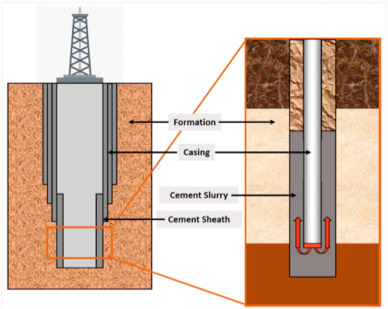
II. The Mikem Advantage: How Our HEC Stabilizes Cement Slurries
Unlike standard thickeners, Mikem’s Hydroxyethyl Cellulose is synthesized through a highly controlled alkalization and etherification process, yielding a non-ionic polymer with exceptional purity and molecular uniformity. In low-density cement systems, our HEC delivers superior anti-settling performance through three core mechanisms:
1. Advanced Thickening and Yield Stress Enhancement
The moment Mikem’s HEC hydrates, its extended molecular chains entangle to form a robust three-dimensional network within the aqueous phase. This significantly boosts the apparent viscosity and dynamic shear stress of the slurry. By providing a high initial yield stress, our HEC effectively locks solid particles in place, instantly arresting downward settling and upward filler migration.
2. Powerful Adsorption Bridging Effect
The polar hydroxyl and ether groups along the Mikem HEC polymer chain act as anchors. They strategically adsorb onto the surfaces of both cement grains and lightweight cenospheres, creating a loose but resilient flocculated network. This “bridging” synergizes the entire solids phase, dramatically upgrading the overall suspension capacity of the slurry.
3. Superior Fluid-Loss Control
Beyond suspension, Mikem HEC serves as a premier fluid-loss control additive. As the slurry is pumped downhole, HEC polymers form a microscopic, highly dense, and impermeable filter cake against the wellbore wall. This prevents interstitial water from escaping into the formation, eliminating localized density spikes and minimizing free water generation.
Why choose Mikem over CMC? Because our HEC is entirely non-ionic, it boasts unparalleled tolerance to multivalent cations (like calcium) and high salinity environments. It provides predictable rheology in complex brines and exhibits a highly mild retarding effect, making it universally compatible with your existing dispersants and retarders.
III. Key Design Considerations for Your Slurry Formulation
Building a fail-safe low-density cement slurry requires a holistic approach to formulation. When integrating Mikem HEC, we recommend the following technical framework for optimal field performance:
- Cementitious Base & Extenders: Utilize API Class G oil-well cement as the foundation. Incorporate cenospheres (0.40–0.60 g/cm³) as the primary lightweight filler, supplemented with 8%–15% BWOC microsilica to optimize particle size distribution and compressive strength.
- Water-to-Cement (W/C) Ratio Control: Maintain a W/C ratio between 0.80 and 1.20. Mikem HEC imparts excellent lubricity and flowability, allowing you to operate at the lower end of this ratio, inherently reducing the risk of free fluid.
- Precision HEC Dosage: The standard dosage for Mikem HEC ranges strictly from 0.2% to 0.6% BWOC. Thanks to our rigorous batch-to-batch consistency, formulators can rely on precise dosages without fear of viscosity spikes. Exact concentrations should be calibrated via lab testing against specific Bottom Hole Circulating Temperatures (BHCT).
- Synergistic Additives: To balance the static suspension with dynamic pumpability, pair our HEC with sulfonated aldehyde-ketone dispersants. This creates a highly desirable “shear-thinning” profile—fluid during pumping, yet instantly gelled when static.
IV. Field Implementation and Mixing Strategy
As a direct manufacturer, Mikem not only supplies premium raw materials but also provides the technical guidelines to ensure field success. Proper slurry preparation is non-negotiable.
Material Selection: Mikem offers specialized viscosity grades (typically targeting a 2% aqueous solution viscosity of 300–600 mPa·s). This specific molecular weight range guarantees rapid dissolution without the dreaded “fish-eye” clumping commonly seen in lower-tier products.
The Dry-Mix/Wet-Mix Protocol:
- Dry Blending: Thoroughly homogenize Mikem HEC powder with the dry cement and cenospheres. This guarantees that the polymer particles are uniformly distributed across the solid phase.
- Hydration: Introduce the mix water under high-shear agitation. Allow 10–15 minutes of continuous mixing to ensure the cellulose chains are fully hydrated and expanded. (For offshore rigs, pre-hydrating a 2% mother solution can accelerate this process).
Quality Assurance Metrics: Before pumping, verify performance against API specifications. A properly formulated Mikem HEC slurry will exhibit a static settling density differential of ≤ 0.05 g/cm³ and a free fluid content rigidly controlled below 1.4%.

V. Driving Efficiency in Deep-Well Cementing
Field data from our global B2B partners confirms that low-density slurries (1.30–1.50 g/cm³) fortified with Mikem HEC consistently achieve free fluid levels below 1.0%, with zero instances of catastrophic bridge-settling. Furthermore, pumpability remains excellent (20–24 cm flowability), ensuring smooth displacement mechanics.
For ultra-deep, high-temperature wells (BHCT > 90°C), Mikem’s technical team can assist in formulating composite suspension systems—blending our HEC with specific thermal stabilizers or biopolymers (like xanthan gum) to maintain structural integrity under extreme geothermal stress.
Partner with Mikem for Unmatched Cementing Reliability
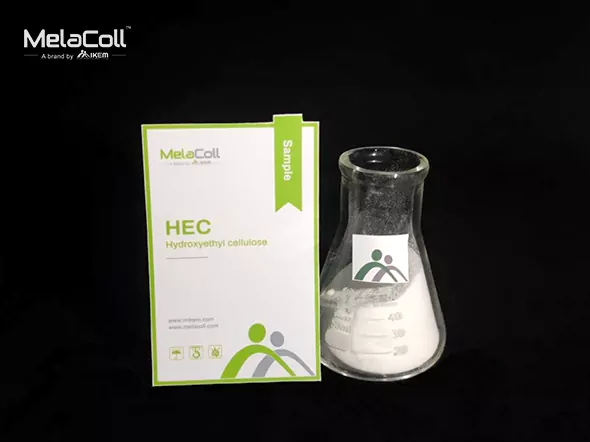
The integrity of a well is only as strong as the cement that seals it. By choosing Mikem’s Hydroxyethyl Cellulose, oilfield service companies and chemical distributors are investing in uncompromised suspension stability, flawless fluid-loss control, and the peace of mind that comes from a world-class manufacturing supply chain.
As a dedicated manufacturer, Mikem guarantees stable pricing, rapid global logistics, and rigorous ISO-certified quality control. We don’t just sell chemicals; we deliver formulation confidence.
Ready to upgrade your well cementing formulations?
Stop letting settling issues compromise your operations. Contact the Mikem Chemical sales team today to request the latest Technical Data Sheets (TDS), Certificates of Analysis (COA), or to secure a free testing sample for your laboratory. Let us help you engineer the perfect slurry.
