Why Do Powder Laundry Detergents Need a Builder?
A laundry detergent can contain effective surfactants and still deliver disappointing cleaning results, particularly when it is used in hard water. Calcium and magnesium ions interfere with the performance of certain surfactants, especially some anionic types. Depending on the formulation, these ions can reduce cleaning efficiency, encourage mineral deposits and make it harder to maintain consistent washing results.
This is one reason detergent manufacturers pay so much attention to builders. Surfactants are responsible for loosening oily soils, wetting fabric surfaces and helping dirt move into the wash water. Builders work alongside them, controlling water hardness, managing mineral ions and creating conditions in which the cleaning system can perform more effectively.
Sodium Tripolyphosphate (STPP) has long been an important phosphate-based builder in powder laundry detergents. Its ability to bind calcium and magnesium ions, disperse particulate soils and contribute alkalinity makes it particularly useful in formulations where these functions are required.
Although phosphate restrictions have encouraged manufacturers to explore alternative builders, STPP remains relevant in markets where its use is permitted. Understanding how it works, and how it interacts with other detergent ingredients, helps manufacturers make better formulation decisions.
What Is Sodium Tripolyphosphate (STPP)?
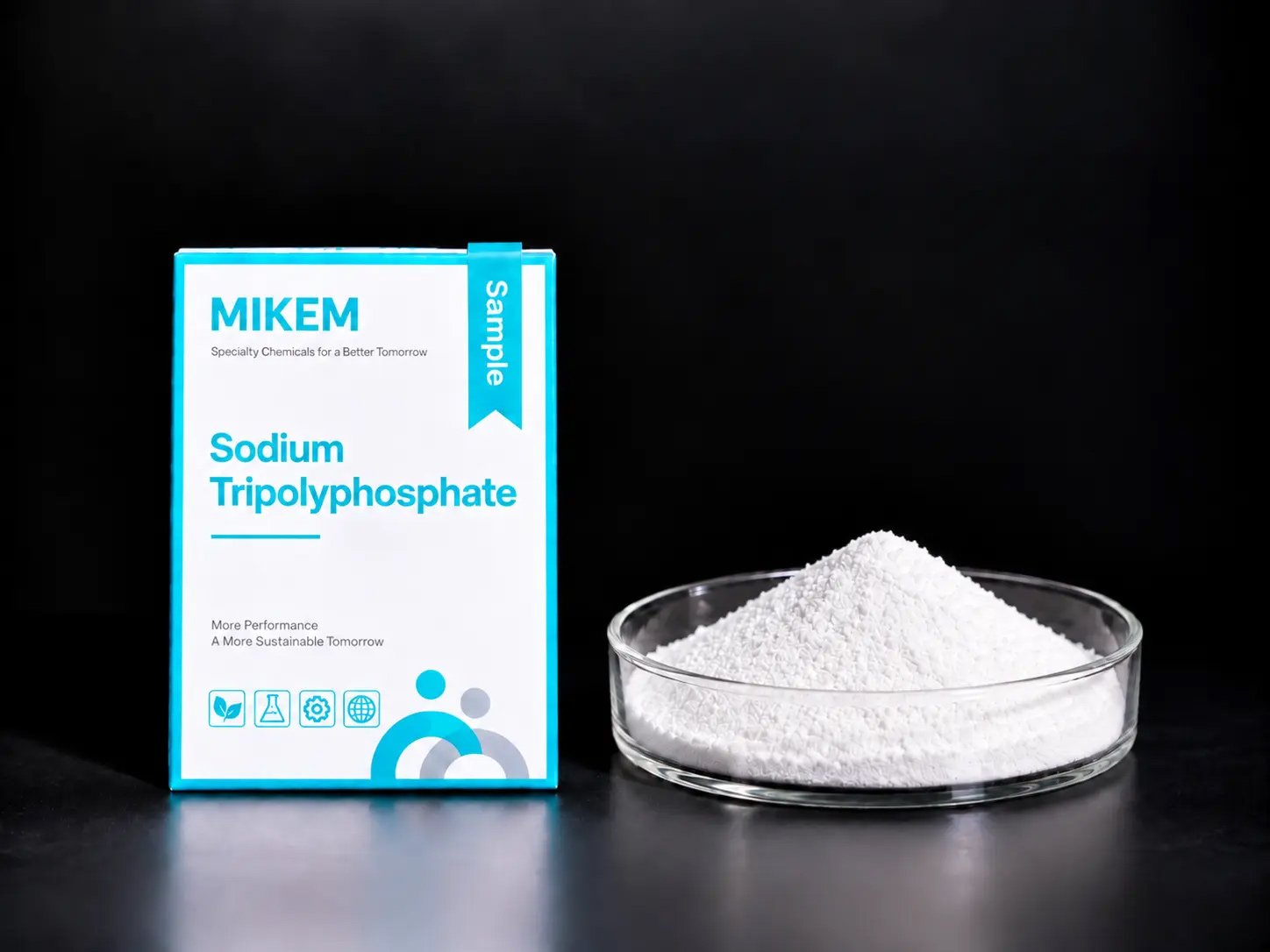
Sodium Tripolyphosphate, commonly known as STPP, is an inorganic phosphate compound with the molecular formula Na₅P₃O₁₀ and CAS number 7758-29-4. It is generally supplied as a white powder or granular material and is soluble in water.
In detergent manufacturing, STPP is primarily used as a builder rather than a surfactant. It does not remove oily stains in the same way as surfactants. Instead, it helps control the chemical conditions of the washing process, particularly the presence of hardness ions that can interfere with cleaning.
Its main functions include:
- Water softening: Binding calcium and magnesium ions to reduce their interference with detergent ingredients.
- Soil dispersion: Helping keep detached particulate dirt distributed in the wash liquor.
- Anti-redeposition support: Contributing to the prevention of suspended soil returning to fabric surfaces.
- Alkalinity and buffering: Supporting the pH conditions required by many detergent systems.
- Formulation versatility: Working alongside surfactants, polymers, enzymes and other builders in suitable cleaning formulations.
These properties explain why STPP has traditionally been used in household laundry powders, heavy-duty detergents and selected industrial cleaning products.
How Does STPP Improve Powder Laundry Detergent Performance?
The value of STPP becomes clearer when its functions are considered in relation to the actual washing process. It does not replace the cleaning ingredients in a detergent. Rather, it helps them work under more favorable conditions.
1. Controlling Water Hardness and Protecting Surfactant Performance
Water hardness is one of the most important factors affecting laundry detergent performance. Calcium and magnesium ions are naturally present in many water supplies, and their concentrations can vary significantly between regions.
These ions can create particular problems for anionic surfactants. Some anionic surfactants react with calcium or magnesium to form poorly soluble salts, reducing the amount of surfactant available for effective cleaning. Even when precipitation does not occur, hardness ions can change the behavior of the overall washing system.
STPP addresses this issue through sequestration. It forms soluble complexes with calcium and magnesium ions, reducing the concentration of free hardness ions in the wash water.
This is especially useful in powder detergent formulations designed for hard-water conditions. Instead of requiring surfactants to work against high mineral concentrations, the builder helps create a more favorable environment for soil removal.
Nonionic surfactants are generally less sensitive to water hardness, but that does not make builders unnecessary. In mixed surfactant systems, STPP can still contribute to overall water conditioning and formulation performance.
2. Improving Soil Dispersion and Reducing Redeposition
Removing dirt from clothing is only half the job. Once soil has been detached from fabric, it needs to remain dispersed in the washing liquid until the wash and rinse cycles are complete.
Without sufficient dispersion, particulate dirt may aggregate or settle back onto fabric surfaces. This process, known as soil redeposition, can leave clothes looking dull or grey even after washing.
STPP helps maintain the dispersion of particulate soils and reduces their tendency to form deposits. Its contribution is particularly relevant when washing heavily soiled textiles, where relatively large amounts of suspended dirt enter the wash liquor.
However, STPP does not perform this task alone. Modern detergent formulations often contain polymeric anti-redeposition agents, including Sodium Carboxymethyl Cellulose (Sodium CMC) and polyacrylates.
These ingredients have different but complementary functions. STPP helps manage mineral ions and particulate soil dispersion, while polymeric additives help keep detached dirt from attaching to fabric again.
For detergent manufacturers, balancing these ingredients is more effective than expecting a single builder to handle every aspect of soil control.
3. Supporting Alkalinity and Washing Conditions
Many powder laundry detergents are formulated to operate under alkaline conditions. A suitable pH helps improve the removal of greasy soils and supports the performance of several cleaning ingredients.
STPP contributes alkalinity and buffering capacity to the washing system, helping maintain conditions suitable for detergent performance.
It is important, however, to consider its role alongside other alkaline builders.
Sodium Carbonate is commonly used as a major source of alkalinity in powder detergents. Sodium Silicate may also be incorporated to contribute alkalinity and provide additional formulation functions. STPP complements these ingredients through its own combination of sequestration, dispersion and buffering properties.
The final pH of the washing solution depends on the entire builder system, detergent dosage and washing conditions. Simply increasing the STPP content does not automatically produce a better formulation.
4. Helping Control Mineral Deposits
Hard-water minerals can accumulate on fabrics and washing equipment when they are not adequately controlled. Over time, mineral deposits may affect fabric appearance and washing machine cleanliness.
STPP helps reduce this risk by binding hardness ions before they can participate in unwanted precipitation reactions.
This function is particularly relevant in detergent systems containing alkaline ingredients such as sodium carbonate, which can react with calcium to form calcium carbonate deposits.
When STPP is combined with suitable dispersants and other builders, the formulation can achieve better control over mineral-related problems.
The actual result depends on water hardness, ingredient ratios and the washing environment, so formulation testing remains important.
The Role of STPP in Different Powder Laundry Detergent Formulations
Not every laundry detergent has the same cleaning requirements. A product intended for everyday household washing is different from one designed for heavily soiled workwear or commercial textile processing.
STPP can be considered in several types of formulations, depending on local regulations and the desired performance.
Heavy-Duty Powder Laundry Detergents
Heavy-duty detergents are designed to remove substantial soil loads from workwear, household textiles and frequently washed garments. STPP can help manage hardness ions and maintain soil dispersion, supporting the performance of surfactants and other cleaning ingredients.
General-Purpose Laundry Powders
General-purpose products need to perform reliably across different fabric types, water conditions and everyday soil levels. STPP can serve as a multifunctional builder where phosphate use is permitted, helping manufacturers balance cleaning performance and formulation requirements.
Industrial and Institutional Laundry Detergents
Commercial laundries often process large volumes of textiles under controlled washing conditions. Water quality, detergent concentration, washing temperature and textile contamination all influence builder selection. STPP may be considered in suitable industrial formulations, subject to the applicable environmental and regulatory requirements.
Concentrated Powder Detergents
Concentrated formulations require careful control over ingredient proportions and powder characteristics. STPP can provide useful builder functionality, but manufacturers must also consider dissolution behavior, particle size and compatibility with the other ingredients in the concentrated system.
Important Formulation Considerations When Using STPP
Selecting STPP is not simply a matter of adding a fixed amount to a detergent recipe. Its effectiveness depends on how it works with the rest of the formulation and whether the finished powder meets production and performance requirements.
Water Hardness and Builder Demand
Manufacturers should evaluate the hardness of the target market’s water supply before determining the builder system.
A formulation designed for relatively soft water may not deliver the same results in regions with high calcium and magnesium concentrations. Water hardness, washing temperature, detergent dosage, wash time and soil load all influence the amount of builder functionality required.
Laboratory trials under representative washing conditions are therefore essential when developing or adjusting a formulation.
Compatibility With Other Detergent Ingredients
STPP is commonly combined with other functional ingredients rather than used as the sole builder.
For example, sodium carbonate provides alkalinity, while polymeric dispersants help manage suspended soil and mineral deposits. Surfactants remain responsible for the main soil-removal process, and enzymes target specific stains such as proteins, starches and fats.
Bleaching systems may also be included to improve the removal of colored stains.
These ingredients must be selected as a complete system. Manufacturers should evaluate compatibility, pH, storage stability and cleaning performance, particularly when enzymes and sensitive bleaching ingredients are present.
A good formulation is not necessarily the one with the highest total builder content. It is the one in which each ingredient performs a defined function without creating unnecessary cost or stability problems.
Powder Properties and Storage Stability
Chemical composition is only one part of detergent quality. The physical properties of STPP also influence manufacturing and finished-product performance.
Several factors deserve attention:
- Particle Size: Influences blending uniformity and the distribution of ingredients throughout the detergent powder.
- Bulk Density: Affects powder handling, filling and packaging operations.
- Moisture Content: Excess moisture can contribute to caking and storage problems.
- Dissolution Behavior: Influences how quickly the builder disperses in the washing water.
- Phase Composition: Commercial STPP grades may differ in their Phase I and Phase II content, which can affect physical and dissolution characteristics.
Manufacturers should review the relevant technical specifications and test the selected grade in their own formulation. Consistent raw material properties make it easier to maintain uniform production conditions from one batch to another.
Dosage and Formulation Optimization
There is no universal STPP dosage that works for every powder laundry detergent. The appropriate level depends on water hardness, surfactant composition, other builders, washing conditions, product concentration and regulatory limits.
Using too little may leave insufficient hardness control, while excessive builder content can increase formulation costs and contribute unnecessary phosphorus to the finished product.
The best approach is to establish builder demand through formulation trials, comparing cleaning performance, soil redeposition, dissolution and powder stability under realistic washing conditions.
STPP vs. Other Laundry Detergent Builders
STPP is not the only option available to detergent manufacturers. Several alternative builders are used in modern formulations, particularly where phosphate content is restricted or where manufacturers want to develop phosphate-free products.
The important difference is that these materials do not all work in the same way.
| Builder |
Main Function |
Formulation Considerations |
| Sodium Tripolyphosphate (STPP) |
Hardness ion sequestration, soil dispersion and alkalinity |
Phosphorus restrictions and total phosphorus content |
| Sodium Carbonate |
Alkalinity and hardness control through precipitation |
Calcium carbonate deposits and dispersant requirements |
| Zeolite |
Calcium ion exchange |
Insoluble particles, dispersion and comparatively limited magnesium exchange |
| Sodium Citrate |
Metal ion complexing and water conditioning |
Builder efficiency and required concentration |
| GLDA / MGDA |
Chelation of metal ions |
Cost, dosage, biodegradability profile and compatibility |
STPP vs. Sodium Carbonate
Sodium Carbonate is an economical alkaline builder widely used in powder detergents. It helps control water hardness by precipitating calcium ions, but this can also create mineral deposits if the formulation does not contain suitable dispersing agents.
STPP offers a different approach by forming soluble complexes with hardness ions. Its ability to combine sequestration, dispersion and buffering makes it a multifunctional option.
STPP vs. Zeolite
Zeolite is an insoluble builder that removes calcium ions through ion exchange. It is widely used in phosphate-free laundry detergent systems, particularly in formulations designed around solid builder particles.
However, magnesium exchange is generally more limited because hydrated magnesium ions are less readily accommodated by the zeolite structure. Zeolite-based formulations also require appropriate dispersants to maintain good powder and washing performance.
STPP vs. Sodium Citrate
Sodium Citrate is a soluble, phosphate-free builder that complexes metal ions and helps condition washing water. It can be useful in formulations where phosphate reduction is a priority.
However, its performance and the amount required depend on water hardness and the rest of the formulation. It does not necessarily provide the same combination of functions as STPP at equivalent concentrations.
STPP vs. GLDA and MGDA
GLDA and MGDA are aminocarboxylate chelating agents used as alternatives to conventional phosphate builders. They provide effective metal-ion control and are available in formulations designed to reduce phosphorus content.
Their selection involves more than chelation efficiency. Cost, concentration, formulation compatibility and environmental profile all need to be considered.
There is no universal replacement that performs exactly like STPP in every detergent system. Manufacturers should choose a builder combination based on actual washing performance, product requirements and the regulations of the intended market.
Environmental and Regulatory Considerations for STPP
Phosphate-based builders have faced increasing scrutiny because phosphorus released into aquatic environments can contribute to eutrophication. Excessive nutrient enrichment may promote algal growth, reduce dissolved oxygen and disturb aquatic ecosystems.
This environmental concern has led to restrictions on phosphorus content in consumer detergents in several markets.
In the European Union, the detergent regulatory framework places a specific limit on phosphorus in consumer laundry detergents. Under the current requirements, the total phosphorus content must be lower than 0.5 g in the recommended detergent dose for a standard washing machine load under the specified hard-water conditions.
Regulation (EU) 2026/405 retains this limit and will apply from September 23, 2029, replacing Regulation (EC) No 648/2004.
An important distinction is that the current Annex III phosphorus limit applies to consumer laundry detergents. Industrial and institutional laundry detergents are not included in this same limit. However, the European Commission is required to assess the feasibility of introducing phosphorus limits for these product categories by March 23, 2028.
Other countries and regions may apply different requirements concerning phosphate content, wastewater discharge and detergent formulation.
For manufacturers selling internationally, compliance should be assessed at the finished-product level. The amount of STPP used, its phosphorus contribution, the recommended detergent dosage and the product’s intended market all need to be considered before a formulation is approved.
Why Choose MIKEM for Sodium Tripolyphosphate?
For detergent manufacturers, choosing a raw material supplier is about more than finding a competitive price. Consistent product specifications, dependable production resources and clear technical communication all matter, particularly when an ingredient is used in regular, large-scale manufacturing.
MIKEM supplies Sodium Tripolyphosphate (STPP) for detergent and cleaning applications, with a focus on manufacturing resources, product quality and application requirements.
Our approach is built around several practical considerations.
Manufacturing and Production Resources
MIKEM focuses on production capabilities and manufacturing resources that support commercial supply requirements. We understand that detergent manufacturers need raw materials they can source consistently as production volumes change.
Product Specification and Quality Control
STPP quality should be evaluated through measurable technical parameters, not simply its appearance. Relevant specifications may include purity, P₂O₅ content, water-insoluble matter, pH, moisture, particle size and phase composition.
MIKEM emphasizes specification management and quality control to help customers maintain greater consistency in raw material purchasing and formulation development. Product documentation can support customers in evaluating whether a particular grade meets their requirements.
Flexible Commercial Supply
Different detergent manufacturers have different procurement needs. Some require regular bulk quantities for continuous production, while others need supply arrangements suited to changing order volumes and packaging requirements.
MIKEM works with customers to discuss commercial quantities, packaging options and supply arrangements based on their purchasing needs.
Technical and Application Support
Selecting the right STPP grade requires an understanding of its intended application. Our team can assist with product selection, specification matching and application-related inquiries, helping customers evaluate the material against their formulation requirements.
For detergent manufacturers, reliable raw materials are an important part of maintaining consistent production. MIKEM aims to support that process through quality-focused management, manufacturing resources and long-term commercial cooperation.
Learn more about our Sodium Tripolyphosphate product and explore the full MIKEM Home & Personal Care product range.
Frequently Asked Questions
1. What does STPP do in laundry detergent?
STPP acts as a detergent builder. It binds calcium and magnesium ions in hard water, supports soil dispersion, contributes alkalinity and helps surfactants perform more effectively under suitable washing conditions.
2. Is Sodium Tripolyphosphate a surfactant?
No. STPP is an inorganic phosphate builder, not a surfactant. Surfactants help loosen and remove dirt from fabric, while STPP manages water hardness and supports the overall cleaning system.
3. Why is STPP used in powder laundry detergent?
STPP is valued for its multifunctional properties. It provides water softening, hardness ion sequestration, soil dispersion and alkalinity support. These functions make it useful in powder detergents designed for different water conditions and soil loads.
4. Does STPP prevent dirt from redepositing on clothes?
STPP helps disperse particulate soil and supports the prevention of redeposition. However, dedicated polymeric anti-redeposition agents, such as Sodium CMC and polyacrylates, are often used alongside STPP to improve soil suspension and fabric cleanliness.
5. How much STPP should be added to powder laundry detergent?
There is no fixed dosage suitable for every detergent formulation. The required amount depends on water hardness, surfactant composition, other builders, washing conditions and applicable phosphorus restrictions. Manufacturers should determine the appropriate level through formulation trials and regulatory assessments.
6. What is the difference between STPP and Sodium Carbonate?
STPP primarily controls hardness ions through soluble complex formation and also provides soil dispersion and buffering functions. Sodium Carbonate contributes alkalinity and controls calcium hardness mainly through precipitation. The two ingredients can complement each other in suitable powder detergent formulations.
7. Is STPP allowed in laundry detergents in the European Union?
STPP is not universally prohibited in the EU. Consumer laundry detergents must meet the total phosphorus limit of less than 0.5 g in the recommended dose for a standard washing machine load under specified hard-water conditions. Manufacturers must evaluate the finished formulation against the applicable requirements.
Looking for a Reliable Sodium Tripolyphosphate Supplier?
Developing an effective powder laundry detergent requires the right balance of surfactants, builders and functional additives. Water hardness, soil dispersion, powder characteristics and regulatory requirements all influence the final formulation.
MIKEM supports detergent manufacturers with Sodium Tripolyphosphate supply, quality-focused product management and application-oriented technical assistance. Whether you are developing a new powder detergent or looking for a dependable source for regular production, our team is ready to discuss your specifications and supply requirements.
Contact MIKEM to discuss Sodium Tripolyphosphate grades, technical specifications and bulk supply solutions.