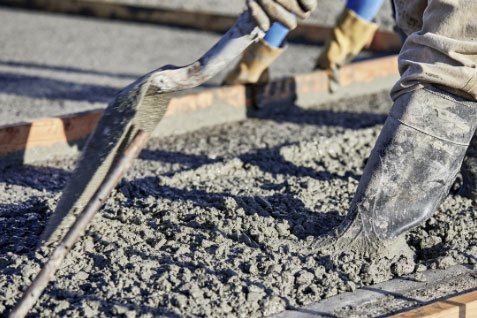
Polypropylene fiber in 3D-printed concrete is attracting increasing attention as construction technology moves toward automated building and advanced cement-based materials. Unlike conventional concrete casting, 3D concrete printing relies on the continuous extrusion of cementitious materials through a printing nozzle. The fresh mixture must remain fluid enough to be pumped and extruded while maintaining sufficient stability to support successive printed layers.
Achieving this balance is one of the biggest challenges in 3D concrete printing. Excessive fluidity can cause printed layers to deform or collapse, while insufficient flowability can lead to nozzle blockage and inconsistent extrusion.
Polypropylene (PP) fiber offers a potential solution by providing distributed reinforcement and modifying the fresh-state behavior of cement-based mixtures.
When properly selected and incorporated, PP fiber can help improve crack resistance, structural stability, and the overall performance of 3D-printed concrete.
For manufacturers developing advanced concrete printing materials, understanding the role of PP fiber is an important step toward producing more reliable and durable formulations.
What Is 3D-Printed Concrete?
3D-printed concrete, also known as 3D concrete printing (3DCP), is an automated construction technology that builds structures by depositing cement-based materials layer by layer.
Instead of using traditional formwork, a computer-controlled printer extrudes specially designed concrete or mortar mixtures through a nozzle according to a digital model.
This technology offers several potential advantages:
- Greater Design Flexibility: Complex shapes and customized structural components can be produced without conventional formwork.
- Reduced Material Waste: Material is deposited only where required by the digital construction model.
- Improved Construction Efficiency: Automated deposition can reduce certain labor-intensive construction operations.
- Flexible Production: Digital models allow manufacturers to produce customized components and architectural structures.
However, 3D-printed concrete requires carefully controlled material properties. The mixture must meet four important performance requirements:
| Performance Requirement |
Function |
| Pumpability |
Allows the mixture to move smoothly through delivery pipes. |
| Extrudability |
Ensures continuous and consistent discharge through the printing nozzle. |
| Buildability |
Enables deposited layers to maintain their shape and support additional layers. |
| Open-Time Stability |
Helps maintain suitable material properties throughout the printing process. |
These requirements make the selection of functional additives and reinforcement materials particularly important.

Why Is Polypropylene Fiber Used in 3D-Printed Concrete?
Polypropylene fiber is a lightweight synthetic reinforcement material widely used in concrete and mortar applications. It is valued for its chemical stability, corrosion resistance, and ability to control microcracking.
In 3D concrete printing, PP fiber has an additional role: it can influence the rheological behavior of fresh mixtures.
When uniformly dispersed, individual fibers form a distributed reinforcement network within the cementitious matrix. This network can influence internal resistance to deformation, structural build-up, and the behavior of the deposited material.
The main benefits include:
Improved Buildability
Buildability refers to the ability of freshly printed concrete to retain its shape and support additional layers without excessive deformation.
PP fibers can increase the resistance of a fresh mixture to deformation by influencing its yield stress and structural build-up.
This can help printed layers maintain their geometry during deposition. However, the effect depends on fiber length, dosage, binder composition, and printing conditions.
Better Crack Control
Concrete can experience shrinkage-related cracking during early curing and subsequent drying.
PP fibers are distributed throughout the cementitious matrix, helping bridge developing microcracks and limit their propagation.
This is particularly relevant for 3D-printed structures, where exposed surfaces, layer interfaces, and material geometry can create different shrinkage conditions.
Enhanced Structural Stability
During printing, each newly deposited layer must support the weight of the layers above it.
A properly designed fiber-reinforced mixture can develop improved resistance to deformation and contribute to more stable printed structures.
The effectiveness of this reinforcement depends on the interaction between fiber characteristics and the overall mix design.
Improved Flexural Performance
PP fibers can help improve the post-cracking behavior of cement-based materials by bridging cracks and transferring stress across developing fracture surfaces.
Depending on the fiber type and formulation, this may improve flexural toughness and resistance to crack propagation.
It is important to distinguish these benefits from conventional structural reinforcement. PP microfibers do not automatically replace steel reinforcement or other structural reinforcement systems.
How PP Fiber Affects the Printability of Concrete
Printability is one of the most important considerations when developing a 3D concrete printing formulation.
Although fiber reinforcement can improve certain properties, excessive fiber addition may also create processing difficulties.
Manufacturers must balance the benefits of reinforcement with the requirements of continuous material extrusion.
Pumpability and Extrudability
PP fibers increase internal interactions within the mixture. At suitable concentrations, this can contribute to improved structural stability. However, excessive fiber content may increase flow resistance and make pumping more difficult.
Fiber length, diameter, dispersion, and nozzle dimensions should therefore be considered together.
Thixotropic Behavior
Thixotropy describes the time-dependent reduction in viscosity under shear and the recovery of structure when the shear is removed.
During 3D printing, the material experiences shear while passing through the delivery system and nozzle. After deposition, it needs to recover sufficient structural strength to support subsequent layers.
PP fiber can influence this structural recovery, helping manufacturers adjust the balance between extrusion and buildability.
Layer Stability
Printed concrete must maintain sufficient shape stability after leaving the nozzle.
A suitable fiber-reinforced formulation can help reduce deformation and support the formation of stable printed layers.
Nevertheless, layer stability also depends on printing speed, layer height, material age, and the setting behavior of the binder system.
Selecting the Right PP Fiber for 3D Concrete Printing
Not all polypropylene fibers perform equally in 3D printing applications. Selecting the appropriate fiber requires consideration of several technical parameters.
Fiber Length
Fiber length affects dispersion, reinforcement efficiency, and extrusion behavior.
Shorter fibers may be easier to distribute in fine mortar systems and can offer a wider processing window. Longer fibers may provide different structural and rheological effects but can increase the risk of fiber entanglement or nozzle obstruction.
Fiber Diameter
Fiber diameter influences the number of individual fibers present at a given dosage and their interaction with the cementitious matrix.
A suitable diameter helps achieve uniform distribution without unnecessarily increasing the internal resistance of the mixture.
Fiber Dosage
Fiber dosage is a critical factor in balancing reinforcement and workability.
Too little fiber may provide insufficient reinforcement, while excessive fiber can reduce flowability and make extrusion inconsistent.
Recent research published in Construction and Building Materials in March 2026 investigated 6 mm and 12 mm PP fibers at different dosages in 3D-printable cementitious mixtures.
The study identified different optimal dosage ranges for the two fiber lengths, demonstrating that fiber geometry and dosage must be evaluated together rather than using a universal dosage recommendation.
For manufacturers, laboratory testing and printing trials are essential before finalizing a formulation.
Fiber Dispersion
Uniform fiber distribution is essential for consistent printing performance.
Poor dispersion can lead to fiber clusters, uneven material flow, and potential nozzle blockage.
A suitable mixing sequence and sufficient mixing time help improve dispersion and maintain formulation consistency.

Why Choose MIKEM Polypropylene Fiber?
Selecting a reliable PP fiber manufacturer is important for maintaining consistent raw material quality and achieving stable formulation performance.
MIKEM specializes in the manufacturing of polypropylene fibers for construction applications, supporting concrete and mortar producers with dependable products and customized solutions.
Key advantages include:
In-House Manufacturing
MIKEM operates its own manufacturing facility, maintaining direct control over production processes and product quality rather than relying solely on external sourcing.
Consistent Product Specifications
MIKEM polypropylene fiber is manufactured using 100% virgin polypropylene.
Available specifications include:
| Parameter |
Specification |
| Material |
100% Virgin Polypropylene |
| Diameter |
30–32 μm |
| Length |
3–20 mm |
| Tensile Strength |
≥500 MPa |
| Packaging |
Customized |
Specific fiber specifications can be discussed according to application requirements.
Flexible Customization
Different 3D printing systems may require different fiber lengths and material characteristics.
MIKEM supports customized fiber specifications to help customers evaluate suitable options for their formulations and processing conditions.
Quality Control and Technical Support
MIKEM focuses on manufacturing consistency, product quality management, and technical support.
Our team works with customers to identify suitable fiber specifications and evaluate their compatibility with cement-based formulations.
For manufacturers exploring PP fiber reinforcement in advanced concrete applications, reliable product quality is an important starting point.
Conclusion
The development of 3D-printed concrete requires more than advanced printing equipment. It also depends on carefully engineered material formulations that balance flowability, buildability, crack resistance, and long-term performance.
Polypropylene fiber offers an effective reinforcement option for manufacturers seeking to optimize these properties.
With its in-house manufacturing capabilities, consistent product specifications, and flexible customization services, MIKEM supports customers developing advanced concrete and mortar formulations.
Looking for a Reliable Polypropylene Fiber Manufacturer?
Contact MIKEM to discuss your requirements, request product specifications, and explore suitable PP fiber solutions for your construction applications.