Introduction
Polypropylene fiber dosage in concrete depends on the fiber type, mix design, placement conditions, and performance goal. PP fibers are added to help control cracking and improve fresh or hardened concrete performance. A common question is: how much polypropylene fiber should be used per cubic meter of concrete?
There is no single dosage that fits every PP fiber. Fiber length, geometry, the concrete mix, placement conditions, and the performance target all matter. As a general reference, monofilament microfibers are often used at about 0.3–0.9 kg/m³, while fibrillated microfibers commonly start at around 0.9 kg/m³. Synthetic macrofibers are used at higher rates, often starting around 1.8 kg/m³, with the final dosage set by the required performance and project design. Always follow the product data sheet and the project specification.
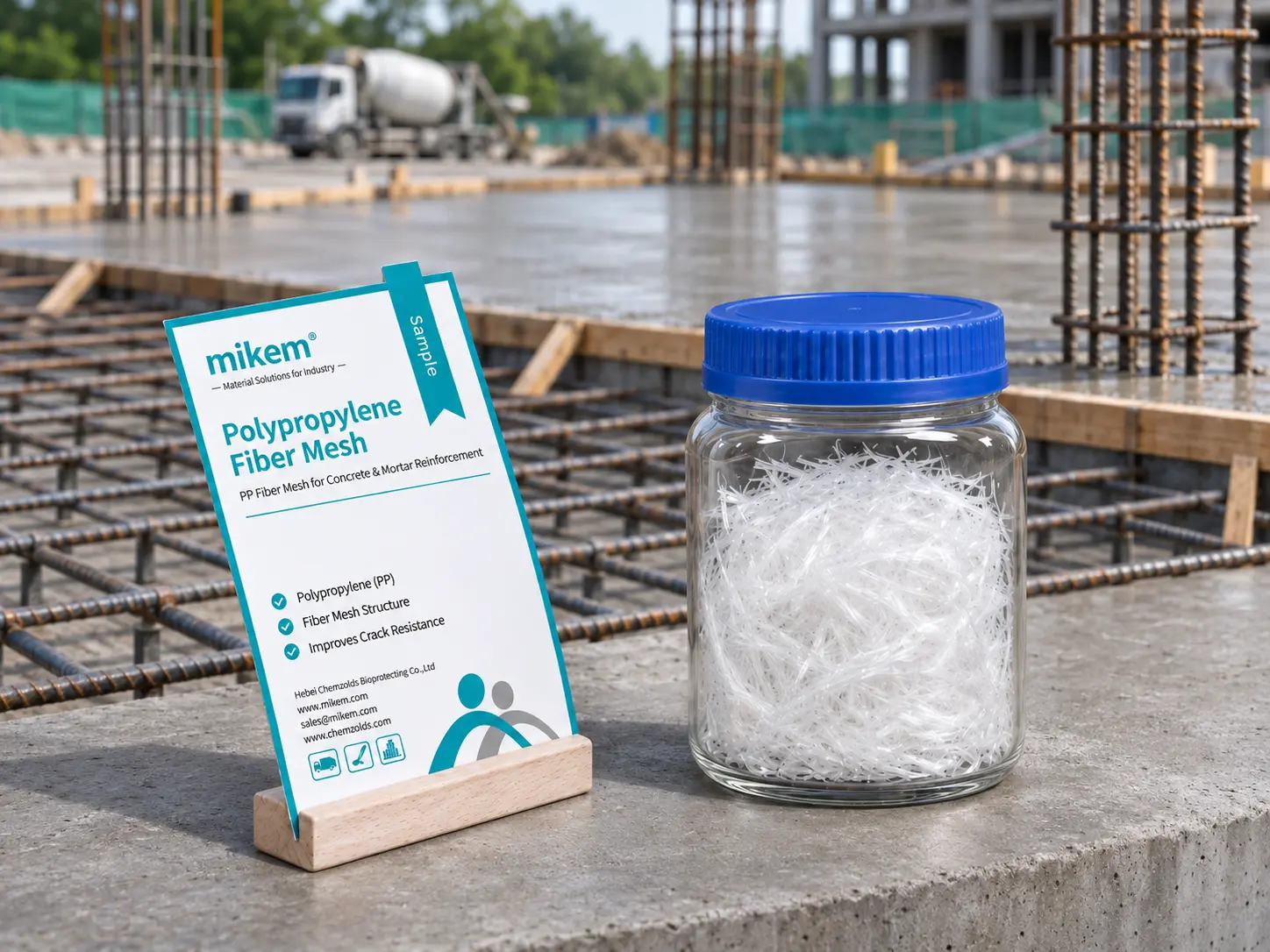
The key is to identify the fiber type first. Microfibers are mainly used to help limit early-age plastic shrinkage cracking. Macrofibers are designed to contribute to post-crack performance and toughness, and in some applications may be specified as part of an engineered reinforcement system. These products are not interchangeable by weight.
Polypropylene Fiber Dosage in Concrete: Typical Ranges
The following ranges are useful for preliminary planning. They are not a substitute for a product-specific recommendation or a project mix design.
| PP fiber type |
Common dosage reference |
Typical purpose |
| Monofilament microfiber |
About 0.3–0.9 kg/m³ |
Help control plastic shrinkage cracking |
| Fibrillated microfiber |
At least about 0.9 kg/m³; some mixes use more |
Help control early-age cracking and improve fiber distribution |
| Synthetic macrofiber |
Often from about 1.8 kg/m³, with higher rates selected as required |
Improve post-crack behavior, toughness, and crack-width control |
ACI’s technical guidance gives 0.3–0.9 kg/m³ as a typical range for monofilament synthetic microfibers and at least 0.9 kg/m³ for fibrillated microfibers. It gives a typical range of 1.8–6.0 kg/m³ for synthetic macrofibers, depending on the application and performance requirements. These are category-level references: an individual manufacturer’s product may have a narrower or different recommended range.
For standard flatwork mixes, 0.6–0.9 kg/m³ is a practical microfiber range to discuss with the supplier. ACI’s broader range includes lower rates, so check the specific fiber geometry and product data.
Macro PP fiber dosage is selected to meet post-crack performance criteria such as residual flexural performance or toughness. Requirements vary with fiber dimensions, mix, and application. Any design using macrofibers in place of conventional reinforcement needs project-specific engineering and verification.
How to Calculate Fiber Quantity
To calculate polypropylene fiber dosage in concrete for a batch, multiply the approved rate by the concrete volume:
Total fiber required (kg) = dosage (kg/m³) × concrete volume (m³)
For example, if the approved dosage is 0.6 kg/m³:
- 1 m³ of concrete needs 0.6 kg of fiber.
- 10 m³ needs 6 kg.
- 50 m³ needs 30 kg.
At 0.9 kg/m³, the same 50 m³ project needs 45 kg. For a 100 m³ pour, the total would be 60–90 kg at a dosage of 0.6–0.9 kg/m³.
Use the dosage specified for the exact fiber product and application. Do not convert a published dosage to a percentage of cement weight unless the specification explicitly calls for that basis. Concrete fiber dosage is commonly stated in kilograms per cubic meter of concrete, not as a universal percentage of cement.
What Affects the Right Dosage?
1. Fiber geometry and form
Monofilament, fibrillated, and macrofibers have different dimensions and functions. A higher fiber count or a fibrillated structure may change how the fibers disperse and how the fresh mix behaves. The dosage for a 12 mm microfiber cannot automatically be applied to a longer macrofiber.
2. Concrete mix design
Cementitious content, aggregate grading, water, admixtures, and workability affect dispersion and finishability. Mortars and fine-rich mixes may need special attention. Confirm that the full formulation remains placeable and finishable.
3. Exposure and placement conditions
Hot weather, wind, low humidity, large exposed surfaces, and delayed curing can increase plastic shrinkage risk. These conditions may affect fiber selection and dosage, but fibers do not replace curing, jointing, or good placement practices.
4. Performance objective
Microfibers may suit early-age crack control. Macrofibers may suit specified residual strength or post-crack capacity. Define and test against the performance target before selecting dosage.
5. Pumping, finishing, and surface requirements
Fiber content and geometry can affect slump, pumping, surface appearance, and finishing. Make a trial batch when introducing a fiber or changing dosage, then review fresh concrete and finish before scale-up.
How to Add PP Fiber to Concrete
Correct dosage depends on uniform dispersion. Follow the fiber supplier’s instructions and the plant’s approved procedure:
- Confirm the fiber type and dosage. Check the product data sheet, project documents, and batch size before production.
- Measure the fiber accurately. Use the specified mass for the concrete volume in the batch. Avoid estimating by handfuls or partial bags.
- Add the fibers gradually. Introduce them in a way that supports dispersion and minimizes clumping. Do not add a large quantity as one compact bundle unless the product is specifically packaged for that method.
- Mix for the required time. Follow the supplier’s mixing guidance. ACI notes that after all fibers have been added, mixing should continue for at least 40 drum revolutions—about four to five minutes—to support dispersion; plant procedures and product instructions should also be observed.
- Check the batch. Look for visible fiber balls, uneven distribution, and changes in workability. Adjust the process only within the approved mix design.
- Place, finish, and cure properly. PP fibers do not replace curing, joint planning, or normal quality control.

Common Dosage Mistakes to Avoid
- Applying microfiber guidance to macrofibers. Their dosage and performance purposes differ.
- Assuming more fiber is always better. Unsuitable content can complicate mixing and finishing.
- Reducing dosage below recommendation. This may compromise intended performance.
- Treating fibers as a universal reinforcement replacement. Substitution requires project-specific design and verification.
- Ignoring curing and mix quality. Fibers do not compensate for poor curing, excess water, or improper placement.
- Using a generic online rate as final specification. Confirm the product and project requirements.
Choosing a PP Fiber for Your Concrete Mix
Define the application and performance goal first. Confirm whether the mix needs microfiber for early-age crack control or macrofiber for post-crack performance. Compare fiber length, form, mix compatibility, packaging, and technical data. Trial mixing helps confirm dosage with actual materials and production process.
Why Work with MIKEM for Polypropylene Fiber?
MIKEM is a chemical manufacturer with production control and quality management focused on consistent product performance. Buyers need fiber specifications matched to the application, dependable batch quality, and support during formulation and scale-up.
MIKEM works with customers on fiber type, application, dosage basis, packaging, and supply requirements. Technical support helps evaluate selection and dispersion in concrete or mortar. Confirm product and dosage against the data sheet, trial results, and project requirements.
Frequently Asked Questions
What Is the Recommended Polypropylene Fiber Dosage in Concrete?
For preliminary reference, monofilament microfibers are often used at about 0.3–0.9 kg/m³, while fibrillated microfibers commonly start at around 0.9 kg/m³. Synthetic macrofibers generally use higher rates, often starting around 1.8 kg/m³. The exact dosage depends on the product and required performance.
Can I use 0.9 kg/m³ of PP fiber in every concrete mix?
No. That rate may be suitable for some microfiber products, but it is not a universal dosage. Confirm the fiber form, the manufacturer’s recommendation, and the project specification.
Does polypropylene fiber replace rebar or welded wire mesh?
Microfibers used for plastic shrinkage control do not replace conventional structural reinforcement. Macrofibers may be included in engineered reinforcement designs for certain applications, but any replacement decision requires project-specific structural design and performance verification.
Will adding PP fiber reduce concrete slump?
Fibers can affect workability and finishing depending on the fiber type, dosage, and mix design. Make a trial batch and assess the fresh concrete before production. Do not add water outside the approved mix design to compensate.
Is PP fiber enough to prevent all cracks?
No. Fibers can help control certain types of cracking, but concrete can still crack due to drying shrinkage, thermal movement, restraint, loading, poor curing, or other factors. Joint design, placement, curing, and mix quality remain important.
Get the Right PP Fiber for Your Concrete Application
The right polypropylene fiber dosage depends on fiber type, concrete mix, exposure conditions, and the performance target. Confirm the product recommendation, calculate the batch quantity carefully, and verify dispersion and workability with a trial mix.
Looking for a reliable polypropylene fiber manufacturer? Contact MIKEM to discuss your application, product specifications, packaging, and supply requirements. Our team can help you identify a suitable polypropylene fiber option for your concrete or mortar formulation.