In tablet manufacturing, getting a powder blend to compress is only part of the challenge. A formulation may produce tablets with acceptable hardness during initial trials, yet show inconsistent performance when production conditions change. Weak granules, poor powder flow, variable tablet weight, and slow disintegration can all create problems during scale-up.
For pharmaceutical manufacturers, choosing the right excipients is an important part of addressing these issues. Pregelatinized starch is one material worth considering because it can contribute to binding, compressibility, and water interaction within a tablet formulation.
Unlike native starch, which generally requires heating to develop its full gelatinization properties, pregelatinized starch has already undergone a gelatinization process. This gives it different hydration and processing characteristics, making it useful in both wet granulation and selected direct-compression formulations.
Understanding how pregelatinized starch works, how its grades differ, and where it performs best can help formulators make more informed decisions during tablet development.
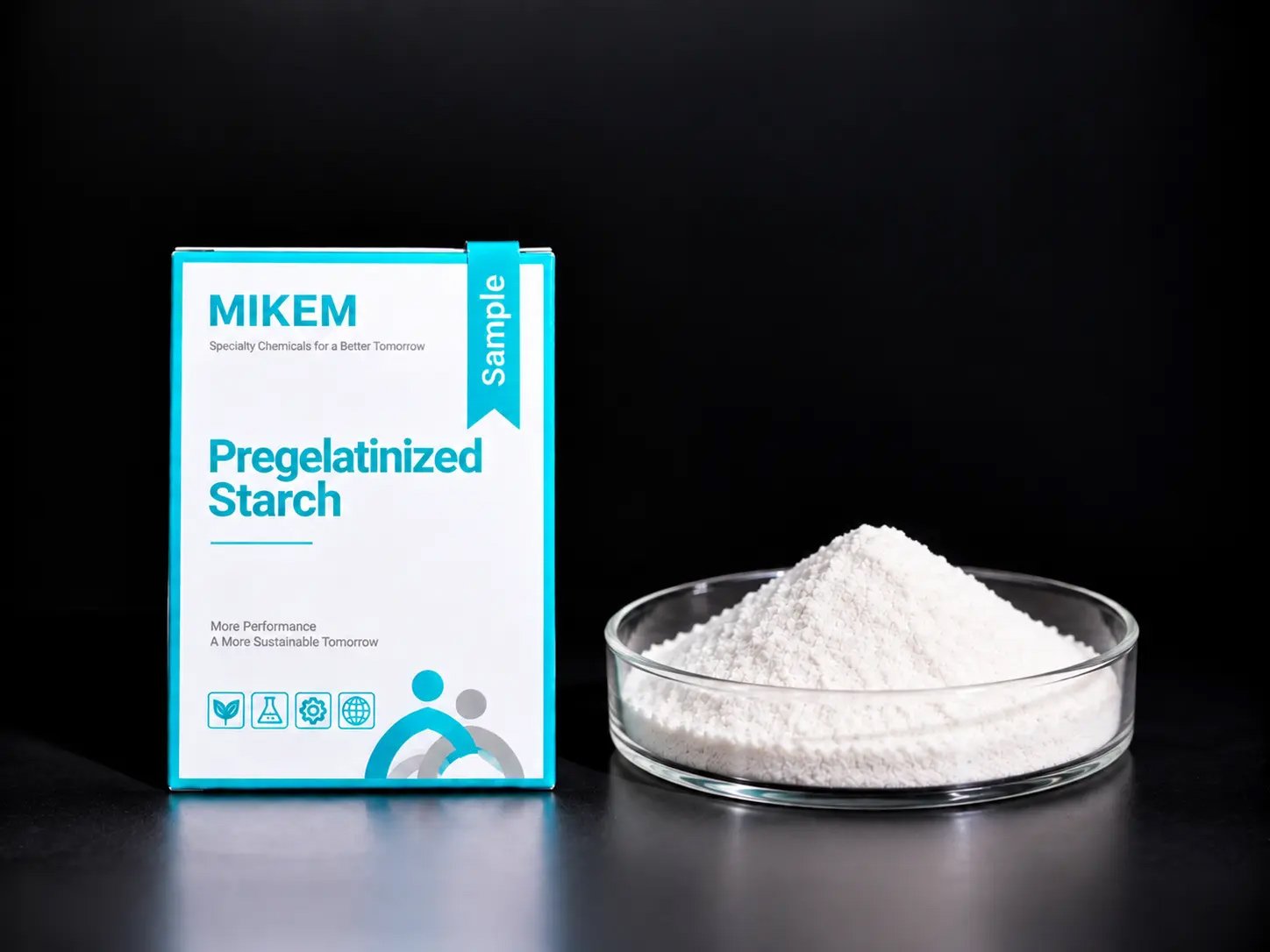
What Makes Pregelatinized Starch Different?
Pregelatinized starch is produced by treating native starch with water and heat to disrupt its original granular structure, followed by drying and milling. Depending on the processing conditions, the resulting material may be fully or partially pregelatinized.
This processing changes how starch behaves when it comes into contact with water. Native starch generally needs heating to gelatinize and develop viscosity. Pregelatinized starch, by comparison, can hydrate in cold water, although its hydration rate and viscosity depend on the degree of gelatinization and the specific grade.
Two broad types are commonly distinguished:
Fully Pregelatinized Starch
Most or all of the original starch granules have undergone gelatinization. These materials can develop viscosity in cold water and are useful where hydration and binding properties are required.
Partially Pregelatinized Starch
Some of the original granular structure remains. This type is widely used in solid dosage formulations because it can provide a combination of binding, compression, and water-related functional properties.
The distinction matters when selecting an excipient. A grade that develops high viscosity may be useful in one formulation but unsuitable for another that requires better powder handling or rapid tablet disintegration.
For manufacturers, the objective is to match the starch’s functional characteristics with the intended production process.
How Pregelatinized Starch Works in Tablet Formulations
Pregelatinized starch is valued for its ability to perform more than one function. Its contribution depends on the grade, concentration, manufacturing method, and interaction with other excipients.
1. Binding and Granule Formation
During wet granulation, powder particles need to form granules with sufficient strength to withstand drying, blending, transfer, and compression. Pregelatinized starch can help bind particles together when hydrated. Its developed viscosity and adhesive properties support the formation of granules with more stable handling characteristics. This can be useful when a formulation produces excessive fines or weak granules that break apart during subsequent processing.
However, adding more binder does not automatically improve the result. Excessive binding may produce hard granules that are difficult to compress or tablets that disintegrate too slowly. The appropriate concentration should be established through formulation trials, taking into account the water content, mixing conditions, and properties of the other ingredients.
2. Compressibility and Tablet Strength
A tablet must maintain its shape throughout production, packaging, transportation, and storage. Certain pregelatinized starch grades can improve compactibility by supporting particle bonding under compression. This helps formulators develop tablets with suitable mechanical strength without relying entirely on other binding agents. Its performance is particularly relevant when working with powder blends that have limited binding capacity.
Tablet hardness, however, is not determined by the excipient alone. Compression force, particle size, moisture content, lubricant concentration, and the characteristics of the active pharmaceutical ingredient all influence the final result. Manufacturers should therefore evaluate tablet hardness together with friability and disintegration rather than treating hardness as the only measure of successful compression.
3. Water Uptake and Tablet Disintegration
A tablet needs enough internal strength to survive handling, but it must also allow water to enter its structure so that it can break apart under the intended conditions. Pregelatinized starch interacts with water through hydration and swelling-related behavior. Depending on its grade and the formulation, this can contribute to tablet disintegration. Partially pregelatinized starch is particularly useful in some formulations because it can provide binding while retaining properties that support water penetration and tablet breakup.
However, it should not automatically be considered a replacement for a dedicated superdisintegrant. If rapid disintegration is a critical product requirement, formulators may still need to use ingredients such as croscarmellose sodium or other suitable disintegrants. The balance between binding strength and water penetration should be evaluated through actual disintegration testing.
Pregelatinized Starch in Direct Compression vs. Wet Granulation
One of the practical advantages of pregelatinized starch is that suitable grades can be considered for different tablet manufacturing processes. The selection criteria, however, are not the same.
Direct Compression
Direct compression involves blending the active ingredient with excipients and compressing the mixture without a separate granulation stage. This process reduces manufacturing steps, but it places greater demands on powder flow, blend uniformity, and compactibility. In direct-compression formulations, suitable pregelatinized starch grades can contribute to particle bonding and tablet formation.
Manufacturers should pay particular attention to:
- Powder flow and die-filling consistency.
- Blend uniformity and segregation risks.
- Compressibility under the selected machine settings.
- Tablet hardness and friability.
- Disintegration after compression.
Not every pregelatinized starch grade is suitable for direct compression. Its performance must be confirmed using the actual powder blend and compression equipment.
Wet Granulation
Wet granulation introduces a liquid to the powder mixture to form granules before drying and compression. Pregelatinized starch can be used as a binder in this process. It may be incorporated as a dry powder followed by liquid addition, or as part of a prepared dispersion, depending on the formulation and manufacturing procedure.
The main considerations include:
- Binder concentration and distribution.
- Granulation liquid quantity.
- Mixing time and granule development.
- Drying conditions and final moisture content.
- Granule size distribution and compression behavior.
The advantage of wet granulation is that it can help improve powder handling and blend uniformity when the starting materials are difficult to process directly.

Pregelatinized Starch vs. Other Common Tablet Excipients
Pregelatinized starch is not necessarily the best option for every tablet formulation. Comparing it with other commonly used excipients helps clarify where it offers practical advantages.
| Excipient |
Main Function |
Important Consideration |
| Pregelatinized Starch |
Binder, filler, and grade-dependent disintegration support |
Offers multifunctional properties |
| Native Starch |
Filler and disintegrant |
Usually requires additional processing to develop binding properties |
| Microcrystalline Cellulose (MCC) |
Filler and dry binder |
Widely used for direct compression and compactibility |
| Povidone (PVP) |
Binder |
Commonly used in wet granulation |
| Croscarmellose Sodium |
Superdisintegrant |
Primarily selected to promote rapid tablet disintegration |
Pregelatinized Starch vs. Native Starch
The main difference is processing and hydration behavior. Pregelatinized starch can hydrate in cold water, making it more convenient when binding or viscosity development is required without a separate gelatinization step.
Pregelatinized Starch vs. Microcrystalline Cellulose
MCC is well established in direct-compression formulations because of its compactibility. Pregelatinized starch provides a different functional profile, particularly where binding and starch-related water interaction are also important.
Pregelatinized Starch vs. Povidone
Povidone is a dedicated binder commonly used in wet granulation. Pregelatinized starch may offer additional functions, depending on the grade, but the two materials are not automatically interchangeable.
Pregelatinized Starch vs. Croscarmellose Sodium
Croscarmellose sodium is designed to promote rapid disintegration. Pregelatinized starch may contribute to tablet breakup, but it should not be assumed to provide the same performance as a dedicated superdisintegrant.
The best choice depends on the formulation objective. In some cases, combining different excipients produces better results than expecting one material to perform every function.
How to Select the Right Pregelatinized Starch Grade
Choosing pregelatinized starch requires more than comparing product names or general specifications. Manufacturers should consider the characteristics that directly affect processing and finished-tablet quality.
1. Degree of Pregelatinization
The degree of gelatinization influences hydration, viscosity development, and the remaining granular structure. Fully and partially pregelatinized grades may behave differently during granulation and compression.
2. Viscosity and Hydration Behavior
These properties affect how the material interacts with water and other formulation ingredients. They are particularly important when the starch is used as a binder in wet granulation.
3. Particle Size and Powder Flow
Particle characteristics influence blending, segregation, and die filling. For direct compression, consistent powder handling is especially important.
4. Moisture Content
Moisture can affect powder flow, compaction, and storage behavior. Manufacturers should evaluate moisture specifications and establish suitable storage conditions.
5. Compression Performance
Tablet hardness, friability, and disintegration time should be tested under representative production conditions. The same starch grade may perform differently in formulations with different active ingredients and excipient combinations.
6. Batch Consistency and Documentation
Consistent specifications are important for repeatable manufacturing. Buyers should review the applicable product specifications, Certificates of Analysis (COA), and technical documentation before qualifying a material.
Laboratory testing should be followed by pilot-scale evaluation before commercial production. This helps identify differences between small-scale formulation results and actual manufacturing performance.
Why Pharmaceutical Manufacturers Choose MIKEM
For pharmaceutical manufacturers, selecting an excipient is also a decision about the reliability of the manufacturing partner behind it. Pregelatinized starch must meet the requirements of the intended formulation, but customers also need confidence in product specifications, quality documentation, and the consistency of future batches.
MIKEM approaches pharmaceutical excipients from a manufacturing perspective.
Rather than focusing only on product availability, MIKEM places emphasis on production management, quality control, and long-term cooperation with industrial customers.
What matters to customers includes:
Manufacturing-Based Quality Control
Product characteristics need to be managed throughout production. Consistent manufacturing controls help customers work with more predictable material specifications.
Consistent Product Specifications
For pharmaceutical manufacturers, changes in moisture, particle characteristics, and other functional properties can affect downstream processing. Clear specifications and batch-related quality records are important when evaluating an excipient manufacturer.
Product Documentation and Technical Communication
COA, technical data, and product specifications help buyers assess whether a material meets their requirements. Clear communication about product characteristics also supports the evaluation and qualification process.
Long-Term Manufacturing Cooperation
Pharmaceutical formulations are rarely developed around a single purchase. Customers need a manufacturer capable of supporting ongoing product requirements, discussing specifications, and maintaining consistent communication throughout the cooperation.
For MIKEM, the goal is to build manufacturing partnerships around reliable product quality and the practical needs of industrial customers.
Looking for a Reliable Pregelatinized Starch Manufacturer?
The right pharmaceutical excipient can make a meaningful difference to formulation development and manufacturing consistency. But choosing the right material requires more than comparing prices or basic product descriptions.
MIKEM works with industrial customers who value manufacturing control, consistent product specifications, and long-term cooperation.
If you are evaluating pregelatinized starch for tablet manufacturing, developing a new formulation, or looking for a dependable manufacturing partner, contact MIKEM to discuss your product requirements.