Developing a good dishwashing liquid involves more than achieving strong cleaning power. Consumers expect the product to remove cooking grease, produce sufficient foam, rinse easily and remain pleasant to use during everyday washing. For manufacturers, these requirements must also be balanced against production costs, raw material consistency and long-term storage stability.
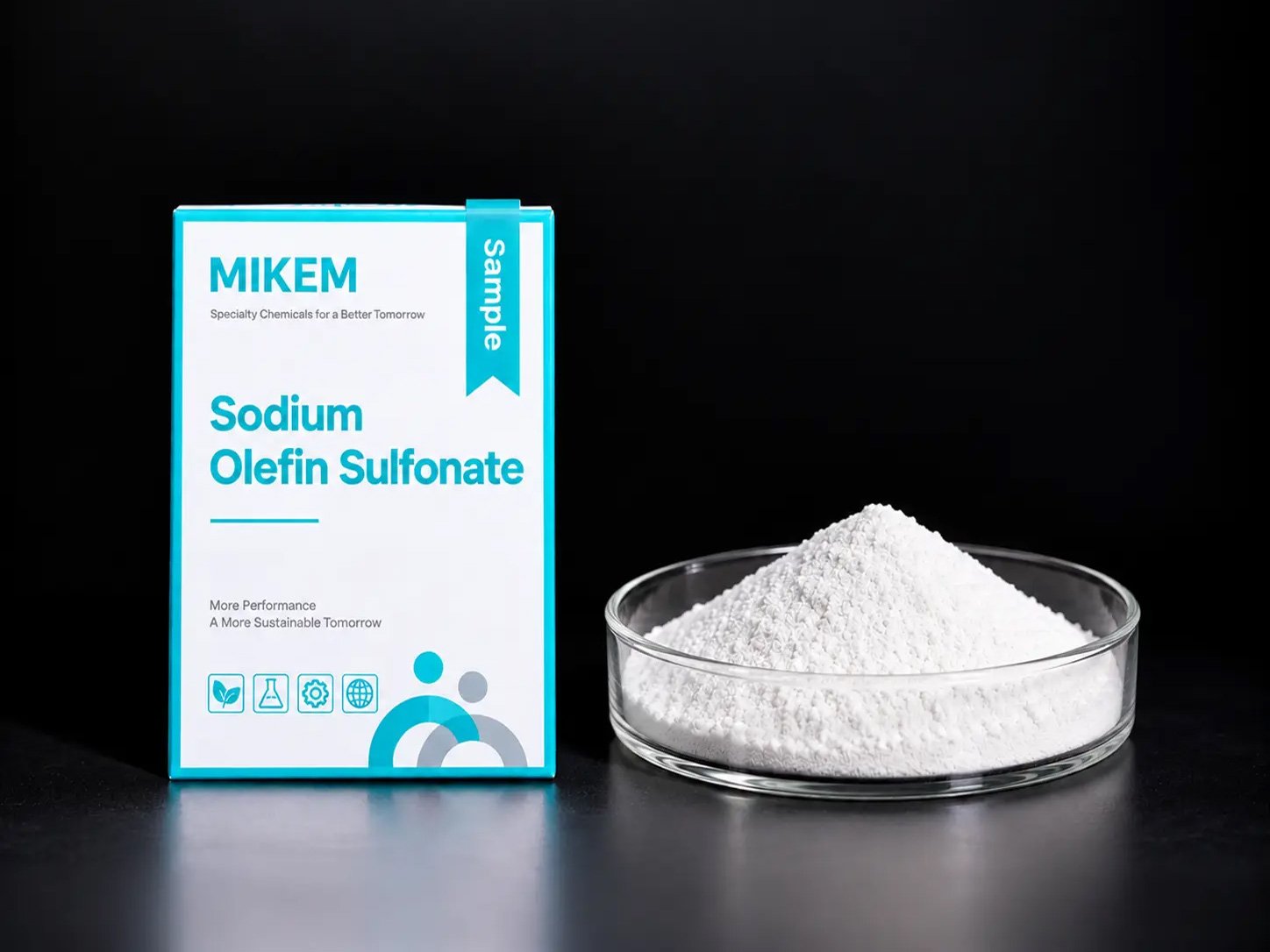
Sodium alpha-olefin sulfonate (AOS) is an anionic surfactant widely used in household cleaning and detergent formulations. Its combination of detergency, foaming ability, wetting performance and hard-water tolerance makes it a practical ingredient in hand dishwashing liquids. Chemical manufacturers such as MIKEM offer powder-grade AOS for household detergents, personal care products and industrial cleaning applications.
Although the benefits of AOS in dishwashing liquid are well established, its performance depends largely on how it is incorporated into the formulation. The choice of co-surfactants, active matter concentration, electrolyte content and processing conditions can all influence the quality of the finished product.
Why Is AOS Used in Dishwashing Liquid?
Commercial AOS typically consists of a mixture of alkene sulfonates and hydroxyalkane sulfonates produced through the sulfonation and subsequent processing of alpha-olefins. Its molecular structure contains a hydrophobic hydrocarbon chain and a hydrophilic sulfonate group, allowing it to interact with both oily substances and water.
This characteristic is particularly useful in dishwashing applications, where food residues often contain a combination of vegetable oils, animal fats, starches, proteins and other substances that cannot be removed effectively with water alone.
For dishwashing liquid manufacturers, AOS offers several functional advantages:
- Effective detergency: Helps loosen and disperse oily food residues from dish surfaces.
- Strong foaming ability: Produces abundant foam suitable for hand dishwashing applications.
- Good wetting performance: Promotes contact between the cleaning solution and contaminated surfaces.
- Hard-water tolerance: Helps maintain cleaning and foaming performance under varying water hardness conditions.
- Formulation versatility: Can be incorporated into systems containing suitable anionic, amphoteric and nonionic surfactants.
These properties make AOS suitable both as a major surfactant component and as part of a blended surfactant system designed to meet specific performance and cost requirements.
How AOS Improves Grease Removal in Dishwashing Liquid
Grease removal is one of the most important performance indicators for hand dishwashing products. Cooking oils and fats adhere readily to glass, ceramic, plastic and metal surfaces, particularly when food residues have cooled or remained on the surface for an extended period.
AOS reduces surface and interfacial tension, allowing the washing solution to spread more effectively across contaminated surfaces. During washing, its hydrophobic chains associate with oily substances, while the hydrophilic sulfonate groups remain compatible with the surrounding water. At suitable concentrations, surfactant aggregates such as micelles help solubilize and disperse oily material, reducing the likelihood of grease being redeposited onto cleaned surfaces.
In practice, however, different types of grease present different cleaning challenges. Fresh vegetable oil is generally easier to remove than cooled animal fat or heavily dried cooking residues. Water temperature, washing time and mechanical action also affect the amount of grease that can be removed.
For formulations targeting heavier kitchen grease, manufacturers may combine AOS with suitable nonionic surfactants to improve oily-soil removal. The most effective surfactant blend is not necessarily the one with the highest active matter concentration, but the one that delivers the required cleaning performance at a commercially acceptable cost.
Balancing Foam Performance and Rinsing
Foam plays an important role in how consumers judge dishwashing liquids. During hand washing, a noticeable reduction in foam often gives users the impression that the detergent has lost its cleaning ability, even though foam volume alone is not a reliable measurement of detergency.
AOS is valued for its ability to generate abundant foam, but initial foam height is only one aspect of product performance. A more useful indicator for dishwashing applications is how well the foam withstands repeated exposure to grease and food residues.
A formulation may produce excellent foam in clean water but lose much of it after several greasy dishes have been washed. For this reason, foam testing should include controlled additions of oily soil rather than relying exclusively on tests conducted in clean water.
The choice of co-surfactants can help manufacturers adjust these characteristics.
| Surfactant |
Main contribution to dishwashing formulations |
| AOS (Sodium Alpha-Olefin Sulfonate) |
Detergency, abundant foam and hard-water tolerance |
| SLES (Sodium Laureth Sulfate) |
Detergency, foaming and viscosity development in suitable blends |
| CAPB (Cocamidopropyl Betaine) |
Foam modification, viscosity adjustment and improved sensory properties |
| Nonionic Surfactants |
Oily-soil removal and complementary detergency |
| APG (Alkyl Polyglucoside) |
Wetting, detergency and foam modification |
Combining AOS with other surfactants allows formulators to adjust cleaning performance, foam persistence, viscosity and user experience. Rinsing should be evaluated separately, since persistent foam does not necessarily indicate that more surfactant residue remains on the dishes.
The Advantages of AOS in Hard-Water Conditions
Water hardness varies considerably between regions, making it an important consideration for manufacturers selling dishwashing products across different markets. Calcium and magnesium ions can interfere with certain cleaning ingredients and contribute to deposits or changes in foam performance.
AOS generally offers better tolerance to hard water than conventional fatty acid soaps. Its calcium-soap dispersing properties can also be useful when dealing with deposits associated with soap and mineral interactions.
Nevertheless, hard-water tolerance does not mean that an AOS-based formulation is unaffected by mineral content. Other ingredients may respond differently to calcium and magnesium ions, influencing the appearance, viscosity and cleaning performance of the finished detergent.
Where water hardness presents a significant challenge, suitable chelating agents may be considered as part of the formulation. Testing the same detergent in soft, moderately hard and hard water provides a more representative assessment of its suitability for different consumer markets.
Key Formulation Considerations When Using AOS Powder
Using AOS powder in a liquid detergent requires particular attention to raw material specifications and processing conditions. Problems that appear to be related to the surfactant itself may actually result from incomplete dissolution, inconsistent active matter concentration or unsuitable electrolyte levels.
1. Calculate Dosage Based on Active Matter
Commercial AOS is available in different physical forms and concentrations. A powder-grade product cannot necessarily be substituted for liquid AOS at the same weight percentage because the amount of active surfactant introduced into the formulation may differ considerably.
Manufacturers should calculate the raw material dosage using the actual active matter specified in the supplier’s technical documentation.
The following example illustrates why this matters:
| Example AOS grade |
Active matter |
Raw material addition |
Active AOS in finished product |
| Hypothetical powder grade |
90% |
5.00% |
4.50% |
| Hypothetical liquid grade |
35% |
5.00% |
1.75% |
These values are illustrative calculation examples, not MIKEM product specifications or recommended formulation dosages.
In addition to active matter, manufacturers should review moisture content, inorganic salt content, unsulfonated matter, pH and appearance where these parameters are included in the product specification. Variations in raw material composition can affect viscosity, color, clarity and production consistency.
2. Establish a Suitable Dissolution Procedure
When incorporating powder-grade AOS into water, the objective is to achieve complete and uniform dissolution without introducing unnecessary air into the mixture. Adding too much powder at once can create concentrated regions that take longer to dissolve, particularly when the formulation already contains other surfactants or electrolytes.
Depending on the grade and production equipment, preparing an aqueous AOS solution before introducing other ingredients may be a practical approach. Water temperature, agitation intensity, addition rate and concentration should be established through laboratory trials and confirmed against the supplier’s processing recommendations.
Electrolytes and other ingredients that significantly alter the surfactant system should generally be introduced at an appropriate stage after dissolution, according to the validated manufacturing procedure.
3. Understand the Relationship Between Salt and Viscosity
Viscosity is an important commercial characteristic of dishwashing liquid. Products that are too thin may be perceived as diluted, while excessively thick formulations can be difficult to dispense.
In suitable mixed surfactant systems, sodium chloride is commonly used to adjust viscosity. However, increasing salt concentration does not always result in a thicker product. Some surfactant blends exhibit a salt-response curve in which viscosity initially increases, reaches a maximum and then declines as more electrolyte is added.
AOS-based formulations may respond differently depending on the ratio of anionic and amphoteric surfactants, total active matter and the presence of other ingredients. Manufacturers should therefore establish a salt-response curve for the actual formulation rather than adopting an electrolyte dosage from another detergent system.
Salt already present in commercial surfactant raw materials should also be considered when evaluating the total electrolyte content.
4. Control pH and Long-Term Storage Stability
A dishwashing liquid that appears clear and homogeneous immediately after production may develop cloudiness, sediment, phase separation or viscosity changes during storage. Fragrances, preservatives, colorants, electrolytes and surfactants can all contribute to these changes.
Stability testing should cover conditions relevant to the product’s intended storage and distribution environment.
| Test item |
Purpose |
| Appearance and clarity |
Identify cloudiness, discoloration or separation |
| Viscosity |
Monitor thickening performance and viscosity drift |
| pH |
Identify changes in formulation conditions |
| High-temperature storage |
Evaluate stability during warm storage and transportation |
| Low-temperature storage |
Identify precipitation, cloudiness or thickening problems |
| Freeze-thaw testing |
Assess resistance to temperature cycling where relevant |
| Packaging compatibility |
Evaluate interactions between the detergent and its container |
| Microbiological quality |
Verify the suitability of the preservation system |
Accelerated testing can help identify formulation weaknesses, but it should be supported by real-time stability evaluation before commercial release.
Balancing Cleaning Performance and Hand-Use Experience
Unlike industrial degreasers or automatic dishwasher detergents, hand dishwashing liquids regularly come into contact with the user’s skin. Strong detergency is desirable, but a formulation designed solely around maximum grease removal may not provide a satisfactory everyday washing experience.
The total surfactant concentration, surfactant combination, pH and exposure conditions can influence the product’s effects on the skin. Amphoteric surfactants such as CAPB may be considered when developing a more balanced formulation, although their contribution must be evaluated within the complete surfactant system.
Manufacturers should avoid assuming that a single surfactant automatically makes a detergent mild. Any claims regarding skin compatibility or mildness should be supported by appropriate finished-product assessment.
How to Evaluate an AOS Dishwashing Liquid Formulation
When introducing AOS into an existing dishwashing liquid, changing several ingredients simultaneously makes it difficult to determine which adjustment is responsible for improved or reduced performance.
A more effective approach is to prepare several formulations with the same total surfactant active matter while varying the proportion of AOS and its co-surfactants. Other ingredients and testing conditions should remain consistent wherever possible.
| Performance indicator |
Evaluation focus |
| Grease removal |
Cleaning performance against standardized oily soils |
| Initial foam |
Foam generation under controlled washing conditions |
| Foam persistence |
Foam retention after repeated grease additions |
| Rinsing |
Ease of removing the washing solution from dish surfaces |
| Hard-water performance |
Cleaning and foam behavior at different water hardness levels |
| Viscosity |
Flow behavior, dispensing and electrolyte response |
| Storage stability |
Changes in appearance, pH and viscosity over time |
This type of controlled comparison allows manufacturers to identify whether increasing the AOS proportion produces a meaningful improvement or whether a different surfactant balance would provide better overall results.
There is no universal AOS dosage suitable for every dishwashing liquid. The appropriate concentration should be determined by the product grade, total active matter, target market, formulation requirements and manufacturing costs.
Why Choose MIKEM as Your AOS Manufacturer?
For commercial detergent manufacturers, purchasing AOS is not simply a matter of comparing prices per kilogram. Differences in active matter, moisture and inorganic salt content can influence formulation costs, viscosity control and batch consistency. These factors become increasingly important when production moves from laboratory trials to large-scale manufacturing.
MIKEM provides Sodium Alpha-Olefin Sulfonate (AOS) in powder form for household detergents, personal care products and industrial cleaning formulations. As a chemical manufacturer, MIKEM focuses on connecting raw material quality with the practical production requirements of its customers.
Controlled Manufacturing and Reliable Quality
Consistent raw material quality helps detergent manufacturers establish repeatable production procedures and reduce unnecessary formulation adjustments. MIKEM emphasizes manufacturing control and quality management to support customers with recurring production requirements.
Application-Oriented Technical Support
Selecting an appropriate AOS grade involves understanding the intended surfactant system, active matter requirements and processing conditions. MIKEM works with customers to discuss product specifications, application compatibility and raw material selection.
Flexible Supply and Packaging
From initial formulation development to commercial production, customers have different requirements for order quantities, packaging and delivery. MIKEM offers flexible supply arrangements based on actual purchasing and production needs.
Long-Term Manufacturing Partnership
Reliable chemical procurement depends on more than an acceptable initial sample. Communication, quality documentation and supply continuity are important throughout the commercial life of a detergent formulation. MIKEM aims to support customers through both product development and ongoing production.
Conclusion
AOS in dishwashing liquid offers a useful combination of grease removal, foaming ability and hard-water tolerance. Its effectiveness, however, depends on more than the properties of the surfactant itself. Raw material specifications, surfactant ratios, dissolution procedures and electrolyte control all play a role in determining whether a formulation performs consistently during production, storage and everyday use.
For detergent manufacturers, selecting a reliable AOS manufacturer and establishing a well-controlled formulation process are important steps toward achieving consistent product quality and competitive production costs.
Looking for a reliable AOS manufacturer for your dishwashing liquid formulation? Contact MIKEM to discuss powder-grade AOS specifications, technical requirements, packaging and commercial supply options.
Frequently Asked Questions
Q1: Can AOS replace SLES in dishwashing liquid?
A: AOS can partially or potentially fully replace SLES in suitable formulations. However, substitution should not be performed on a simple weight-for-weight basis. Differences in active matter, viscosity response, foam characteristics and compatibility require formulation adjustments and performance testing.
Q2: How much AOS should be added to dishwashing liquid?
A: The appropriate AOS dosage depends on its active matter content, the total surfactant concentration and the intended performance of the finished product. Manufacturers should determine the addition level through controlled formulation trials rather than applying a universal percentage.
Q3: Why does an AOS dishwashing liquid become cloudy?
A: Possible causes include incomplete dissolution, excessive electrolyte concentration, low-temperature precipitation or incompatibility with fragrances and other ingredients. Identifying the cause requires reviewing both the formulation and manufacturing process.
Q4: Can sodium chloride thicken AOS-based dishwashing liquid?
A: Sodium chloride can adjust viscosity in certain AOS-based mixed surfactant systems. Its effectiveness depends on the complete formulation. Excessive salt may reduce viscosity or negatively affect product appearance, making salt-response testing important.
Q5: What is the difference between powder and liquid AOS?
A: The main practical differences include active matter concentration, water content, handling requirements and incorporation procedures. Powder-grade AOS may offer advantages in storage and transportation efficiency, but it requires a suitable dissolution process when used in liquid detergents.