Die Entwicklung eines guten Geschirrspülmittels erfordert mehr als nur eine starke Reinigungskraft. Verbraucher erwarten, dass das Produkt Kochfett entfernt, ausreichend Schaum bildet, sich leicht abspülen lässt und bei der täglichen Anwendung angenehm in der Handhabung bleibt. Für Hersteller müssen diese Anforderungen zudem mit Produktionskosten, Rohstoffkonsistenz und langfristiger Lagerstabilität in Einklang gebracht werden.
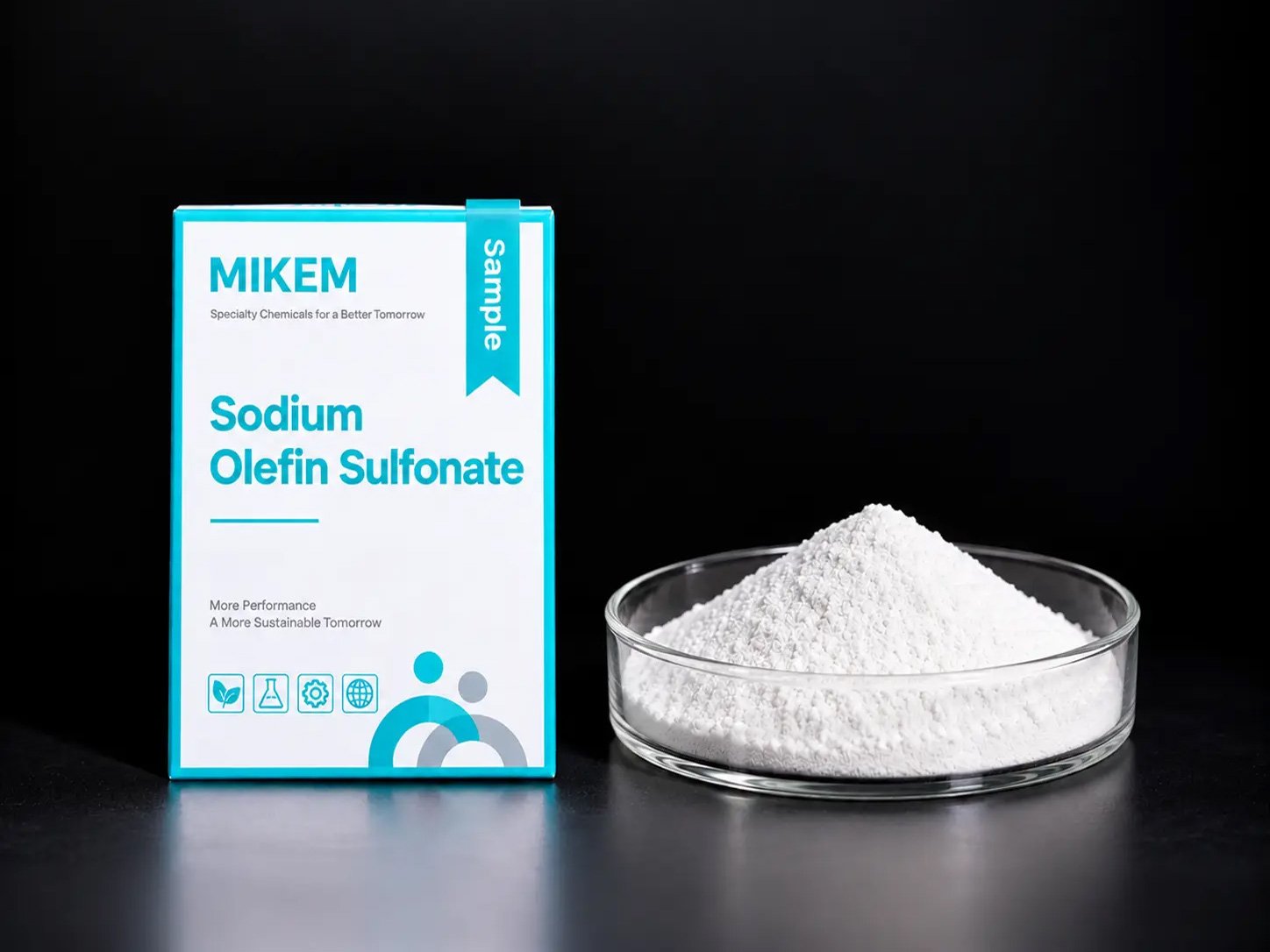
Natrium-Alpha-Olefinsulfonat (AOS) ist ein anionisches Tensid, das häufig in Haushaltsreinigungs- und Waschmittelformulierungen eingesetzt wird. Die Kombination aus Waschkraft, Schaumbildungsvermögen, Benetzungsleistung und Härtewassertoleranz macht es zu einem praktischen Inhaltsstoff in Handgeschirrspülmitteln. Chemiehersteller wie MIKEM bieten AOS in Pulverform für Haushaltswaschmittel, Körperpflegeprodukte und industrielle Reinigungsanwendungen an.
Obwohl die Vorteile von AOS in Geschirrspülmitteln gut belegt sind, hängt seine Leistung weitgehend davon ab, wie es in die Formulierung eingebracht wird. Die Wahl der Co-Tenside, die Aktivstoffkonzentration, der Elektrolytgehalt und die Verarbeitungsbedingungen können alle die Qualität des Endprodukts beeinflussen.
Warum wird AOS in Geschirrspülmittel verwendet?
Kommerzielles AOS besteht typischerweise aus einer Mischung von Alkensulfonaten und Hydroxyalkansulfonaten, die durch Sulfonierung und anschließende Verarbeitung von Alpha-Olefinen hergestellt werden. Seine Molekülstruktur enthält eine hydrophobe Kohlenwasserstoffkette und eine hydrophile Sulfonatgruppe, wodurch es sowohl mit öligen Substanzen als auch mit Wasser interagieren kann.
Diese Eigenschaft ist besonders nützlich in Geschirrspülanwendungen, bei denen Speisereste häufig eine Kombination aus Pflanzenölen, tierischen Fetten, Stärken, Proteinen und anderen Substanzen enthalten, die allein mit Wasser nicht wirksam entfernt werden können.
Für Hersteller von Geschirrspülmitteln bietet AOS mehrere funktionale Vorteile:
- Wirksame Waschkraft: Hilft, ölige Speisereste von Geschirroberflächen zu lösen und zu dispergieren.
- Starkes Schaumbildungsvermögen: Erzeugt reichlich Schaum, der für die Handgeschirrspülung geeignet ist.
- Gute Benetzungsleistung: Fördert den Kontakt zwischen der Reinigungslösung und den verschmutzten Oberflächen.
- Härtewassertoleranz: Hilft, die Reinigungs- und Schaumleistung unter verschiedenen Wasserhärtebedingungen aufrechtzuerhalten.
- Formulierungsvielfalt: Kann in Systeme mit geeigneten anionischen, amphoteren und nichtionischen Tensiden eingebracht werden.
Diese Eigenschaften machen AOS sowohl als Haupttensidkomponente als auch als Teil eines Tensidmischsystems geeignet, das auf spezifische Leistungs- und Kostenanforderungen ausgelegt ist.
Wie AOS die Fettentfernung in Geschirrspülmittel verbessert
Die Fettentfernung ist einer der wichtigsten Leistungsindikatoren für Handgeschirrspülprodukte. Speiseöle und -fette haften leicht an Glas-, Keramik-, Kunststoff- und Metalloberflächen, insbesondere wenn Speisereste abgekühlt sind oder über einen längeren Zeitraum auf der Oberfläche verblieben sind.
AOS reduziert die Oberflächen- und Grenzflächenspannung, wodurch sich die Waschlösung effektiver über verschmutzte Oberflächen ausbreiten kann. Während des Waschens assoziieren seine hydrophoben Ketten mit öligen Substanzen, während die hydrophilen Sulfonatgruppen mit dem umgebenden Wasser kompatibel bleiben. Bei geeigneten Konzentrationen helfen Tensidaggregate wie Mizellen, öliges Material zu solubilisieren und zu dispergieren, wodurch die Wahrscheinlichkeit verringert wird, dass Fett auf gereinigte Oberflächen zurückgelagert wird.
In der Praxis stellen jedoch verschiedene Fettarten unterschiedliche Reinigungsherausforderungen dar. Frisches Pflanzenöl ist im Allgemeinen leichter zu entfernen als abgekühltes tierisches Fett oder stark eingetrocknete Kochrückstände. Wassertemperatur, Waschzeit und mechanische Einwirkung beeinflussen ebenfalls die Menge an Fett, die entfernt werden kann.
Für Formulierungen, die auf schwereres Küchenfett abzielen, können Hersteller AOS mit geeigneten nichtionischen Tensiden kombinieren, um die Entfernung öliger Verschmutzungen zu verbessern. Die wirksamste Tensidmischung ist nicht unbedingt die mit der höchsten Aktivstoffkonzentration, sondern diejenige, die die erforderliche Reinigungsleistung zu kommerziell akzeptablen Kosten liefert.
Ausgewogenheit zwischen Schaumleistung und Abspülverhalten
Schaum spielt eine wichtige Rolle dabei, wie Verbraucher Geschirrspülmittel beurteilen. Beim Handspülen vermittelt eine merkliche Schaumreduzierung den Nutzern oft den Eindruck, dass das Reinigungsmittel seine Reinigungsfähigkeit verloren hat, obwohl das Schaumvolumen allein kein zuverlässiges Maß für die Waschkraft ist.
AOS wird für seine Fähigkeit geschätzt, reichlich Schaum zu erzeugen, aber die anfängliche Schaumhöhe ist nur ein Aspekt der Produktleistung. Ein nützlicherer Indikator für Geschirrspülanwendungen ist, wie gut der Schaum wiederholter Exposition gegenüber Fett und Speiseresten standhält.
Eine Formulierung kann in klarem Wasser hervorragenden Schaum erzeugen, aber nach dem Spülen mehrerer fettiger Teller einen Großteil davon verlieren. Aus diesem Grund sollte die Schaumprüfung kontrollierte Zugaben von öligem Schmutz umfassen, anstatt sich ausschließlich auf Tests in klarem Wasser zu verlassen.
Die Wahl der Co-Tenside kann Herstellern helfen, diese Eigenschaften anzupassen.
| Tensid |
Hauptbeitrag zu Geschirrspülformulierungen |
| AOS (Natrium-Alpha-Olefinsulfonat) |
Waschkraft, reichlich Schaum und Härtewassertoleranz |
| SLES (Natriumlaurylethersulfat) |
Waschkraft, Schaumbildung und Viskositätsentwicklung in geeigneten Mischungen |
| CAPB (Cocamidopropylbetain) |
Schaummodifizierung, Viskositätsanpassung und verbesserte sensorische Eigenschaften |
| Nichtionische Tenside |
Entfernung öliger Verschmutzungen und ergänzende Waschkraft |
| APG (Alkylpolyglucosid) |
Benetzung, Waschkraft und Schaummodifizierung |
Die Kombination von AOS mit anderen Tensiden ermöglicht es Formulierern, Reinigungsleistung, Schaumbeständigkeit, Viskosität und Anwendererlebnis anzupassen. Das Abspülverhalten sollte separat bewertet werden, da anhaltender Schaum nicht unbedingt darauf hindeutet, dass mehr Tensidrückstände auf dem Geschirr verbleiben.
Die Vorteile von AOS unter Härtewasserbedingungen
Die Wasserhärte variiert erheblich zwischen Regionen, was sie zu einem wichtigen Faktor für Hersteller macht, die Geschirrspülprodukte in verschiedenen Märkten vertreiben. Calcium- und Magnesiumionen können bestimmte Reinigungsinhaltsstoffe beeinträchtigen und zu Ablagerungen oder Veränderungen der Schaumleistung beitragen.
AOS bietet im Allgemeinen eine bessere Toleranz gegenüber hartem Wasser als herkömmliche Fettsäureseifen. Seine Calciumseifen-dispergierenden Eigenschaften können auch bei der Behandlung von Ablagerungen nützlich sein, die mit Seifen-Mineral-Interaktionen zusammenhängen.
Dennoch bedeutet Härtewassertoleranz nicht, dass eine AOS-basierte Formulierung vom Mineralgehalt unbeeinflusst bleibt. Andere Inhaltsstoffe können unterschiedlich auf Calcium- und Magnesiumionen reagieren und das Aussehen, die Viskosität und die Reinigungsleistung des fertigen Reinigungsmittels beeinflussen.
Wo die Wasserhärte eine erhebliche Herausforderung darstellt, können geeignete Chelatbildner als Teil der Formulierung in Betracht gezogen werden. Die Prüfung desselben Reinigungsmittels in weichem, mittelhartem und hartem Wasser ermöglicht eine repräsentativere Bewertung seiner Eignung für verschiedene Verbrauchermärkte.
Wichtige Formulierungsüberlegungen bei der Verwendung von AOS-Pulver
Die Verwendung von AOS-Pulver in einem flüssigen Reinigungsmittel erfordert besondere Aufmerksamkeit hinsichtlich der Rohstoffspezifikationen und Verarbeitungsbedingungen. Probleme, die mit dem Tensid selbst zusammenzuhängen scheinen, können tatsächlich auf unvollständige Auflösung, inkonsistente Aktivstoffkonzentration oder ungeeignete Elektrolytgehalte zurückzuführen sein.
1. Calculate Dosage Based on Active Matter
Commercial AOS is available in different physical forms and concentrations. A powder-grade product cannot necessarily be substituted for liquid AOS at the same weight percentage because the amount of active surfactant introduced into the formulation may differ considerably.
Manufacturers should calculate the raw material dosage using the actual active matter specified in the supplier’s technical documentation.
The following example illustrates why this matters:
| Example AOS grade |
Active matter |
Raw material addition |
Active AOS in finished product |
| Hypothetical powder grade |
90% |
5.00% |
4.50% |
| Hypothetical liquid grade |
35% |
5.00% |
1.75% |
These values are illustrative calculation examples, not MIKEM product specifications or recommended formulation dosages.
In addition to active matter, manufacturers should review moisture content, inorganic salt content, unsulfonated matter, pH and appearance where these parameters are included in the product specification. Variations in raw material composition can affect viscosity, color, clarity and production consistency.
2. Establish a Suitable Dissolution Procedure
When incorporating powder-grade AOS into water, the objective is to achieve complete and uniform dissolution without introducing unnecessary air into the mixture. Adding too much powder at once can create concentrated regions that take longer to dissolve, particularly when the formulation already contains other surfactants or electrolytes.
Depending on the grade and production equipment, preparing an aqueous AOS solution before introducing other ingredients may be a practical approach. Water temperature, agitation intensity, addition rate and concentration should be established through laboratory trials and confirmed against the supplier’s processing recommendations.
Electrolytes and other ingredients that significantly alter the surfactant system should generally be introduced at an appropriate stage after dissolution, according to the validated manufacturing procedure.
3. Understand the Relationship Between Salt and Viscosity
Viscosity is an important commercial characteristic of dishwashing liquid. Products that are too thin may be perceived as diluted, while excessively thick formulations can be difficult to dispense.
In suitable mixed surfactant systems, sodium chloride is commonly used to adjust viscosity. However, increasing salt concentration does not always result in a thicker product. Some surfactant blends exhibit a salt-response curve in which viscosity initially increases, reaches a maximum and then declines as more electrolyte is added.
AOS-based formulations may respond differently depending on the ratio of anionic and amphoteric surfactants, total active matter and the presence of other ingredients. Manufacturers should therefore establish a salt-response curve for the actual formulation rather than adopting an electrolyte dosage from another detergent system.
Salt already present in commercial surfactant raw materials should also be considered when evaluating the total electrolyte content.
4. Control pH and Long-Term Storage Stability
A dishwashing liquid that appears clear and homogeneous immediately after production may develop cloudiness, sediment, phase separation or viscosity changes during storage. Fragrances, preservatives, colorants, electrolytes and surfactants can all contribute to these changes.
Stability testing should cover conditions relevant to the product’s intended storage and distribution environment.
| Prüfpunkt |
Purpose |
| Appearance and clarity |
Identify cloudiness, discoloration or separation |
| Viskosität |
Monitor thickening performance and viscosity drift |
| pH-Wert |
Identify changes in formulation conditions |
| High-temperature storage |
Evaluate stability during warm storage and transportation |
| Low-temperature storage |
Identify precipitation, cloudiness or thickening problems |
| Freeze-thaw testing |
Assess resistance to temperature cycling where relevant |
| Packaging compatibility |
Evaluate interactions between the detergent and its container |
| Microbiological quality |
Verify the suitability of the preservation system |
Accelerated testing can help identify formulation weaknesses, but it should be supported by real-time stability evaluation before commercial release.
Balancing Cleaning Performance and Hand-Use Experience
Unlike industrial degreasers or automatic dishwasher detergents, hand dishwashing liquids regularly come into contact with the user’s skin. Strong detergency is desirable, but a formulation designed solely around maximum grease removal may not provide a satisfactory everyday washing experience.
The total surfactant concentration, surfactant combination, pH and exposure conditions can influence the product’s effects on the skin. Amphoteric surfactants such as CAPB may be considered when developing a more balanced formulation, although their contribution must be evaluated within the complete surfactant system.
Manufacturers should avoid assuming that a single surfactant automatically makes a detergent mild. Any claims regarding skin compatibility or mildness should be supported by appropriate finished-product assessment.
How to Evaluate an AOS Dishwashing Liquid Formulation
When introducing AOS into an existing dishwashing liquid, changing several ingredients simultaneously makes it difficult to determine which adjustment is responsible for improved or reduced performance.
A more effective approach is to prepare several formulations with the same total surfactant active matter while varying the proportion of AOS and its co-surfactants. Other ingredients and testing conditions should remain consistent wherever possible.
| Performance indicator |
Evaluation focus |
| Grease removal |
Cleaning performance against standardized oily soils |
| Initial foam |
Foam generation under controlled washing conditions |
| Foam persistence |
Foam retention after repeated grease additions |
| Rinsing |
Ease of removing the washing solution from dish surfaces |
| Hard-water performance |
Cleaning and foam behavior at different water hardness levels |
| Viskosität |
Flow behavior, dispensing and electrolyte response |
| Storage stability |
Changes in appearance, pH and viscosity over time |
This type of controlled comparison allows manufacturers to identify whether increasing the AOS proportion produces a meaningful improvement or whether a different surfactant balance would provide better overall results.
There is no universal AOS dosage suitable for every dishwashing liquid. The appropriate concentration should be determined by the product grade, total active matter, target market, formulation requirements and manufacturing costs.
Why Choose MIKEM as Your AOS Manufacturer?
For commercial detergent manufacturers, purchasing AOS is not simply a matter of comparing prices per kilogram. Differences in active matter, moisture and inorganic salt content can influence formulation costs, viscosity control and batch consistency. These factors become increasingly important when production moves from laboratory trials to large-scale manufacturing.
MIKEM provides Sodium Alpha-Olefin Sulfonate (AOS) in powder form for household detergents, personal care products and industrial cleaning formulations. As a chemical manufacturer, MIKEM focuses on connecting raw material quality with the practical production requirements of its customers.
Controlled Manufacturing and Reliable Quality
Consistent raw material quality helps detergent manufacturers establish repeatable production procedures and reduce unnecessary formulation adjustments. MIKEM emphasizes manufacturing control and quality management to support customers with recurring production requirements.
Anwendungsorientierte technische Unterstützung
Selecting an appropriate AOS grade involves understanding the intended surfactant system, active matter requirements and processing conditions. MIKEM works with customers to discuss product specifications, application compatibility and raw material selection.
Flexible Lieferung und Verpackung
From initial formulation development to commercial production, customers have different requirements for order quantities, packaging and delivery. MIKEM offers flexible supply arrangements based on actual purchasing and production needs.
Long-Term Manufacturing Partnership
Reliable chemical procurement depends on more than an acceptable initial sample. Communication, quality documentation and supply continuity are important throughout the commercial life of a detergent formulation. MIKEM aims to support customers through both product development and ongoing production.
Fazit
AOS in dishwashing liquid offers a useful combination of grease removal, foaming ability and hard-water tolerance. Its effectiveness, however, depends on more than the properties of the surfactant itself. Raw material specifications, surfactant ratios, dissolution procedures and electrolyte control all play a role in determining whether a formulation performs consistently during production, storage and everyday use.
For detergent manufacturers, selecting a reliable AOS manufacturer and establishing a well-controlled formulation process are important steps toward achieving consistent product quality and competitive production costs.
Looking for a reliable AOS manufacturer for your dishwashing liquid formulation? MIKEM kontaktieren to discuss powder-grade AOS specifications, technical requirements, packaging and commercial supply options.
Häufig gestellte Fragen
Q1: Can AOS replace SLES in dishwashing liquid?
A: AOS can partially or potentially fully replace SLES in suitable formulations. However, substitution should not be performed on a simple weight-for-weight basis. Differences in active matter, viscosity response, foam characteristics and compatibility require formulation adjustments and performance testing.
Q2: How much AOS should be added to dishwashing liquid?
A: The appropriate AOS dosage depends on its active matter content, the total surfactant concentration and the intended performance of the finished product. Manufacturers should determine the addition level through controlled formulation trials rather than applying a universal percentage.
Q3: Why does an AOS dishwashing liquid become cloudy?
A: Possible causes include incomplete dissolution, excessive electrolyte concentration, low-temperature precipitation or incompatibility with fragrances and other ingredients. Identifying the cause requires reviewing both the formulation and manufacturing process.
Q4: Can sodium chloride thicken AOS-based dishwashing liquid?
A: Sodium chloride can adjust viscosity in certain AOS-based mixed surfactant systems. Its effectiveness depends on the complete formulation. Excessive salt may reduce viscosity or negatively affect product appearance, making salt-response testing important.
Q5: What is the difference between powder and liquid AOS?
A: The main practical differences include active matter concentration, water content, handling requirements and incorporation procedures. Powder-grade AOS may offer advantages in storage and transportation efficiency, but it requires a suitable dissolution process when used in liquid detergents.