A carton of oat milk should pour smoothly from the first glass to the last. In practice, plant-based drinks can develop sediment, a watery top layer, or a texture that feels too thin or too heavy. For product developers, keeping the drink uniform during processing and storage is a formulation challenge.
Sodium CMC in oat milk can help with suspension and mouthfeel by changing how the liquid phase behaves. But CMC is not a one-ingredient fix for every form of separation. Oat solids, starch, proteins, oil, pH, processing, and storage all affect the finished drink. The useful question is not simply whether to add CMC, but how to make it work with the complete formulation.
Why Oat Milk Can Separate
Oat beverages contain a mixture of water and dispersed components, including oat particles, starch, fiber, protein, and, in many formulas, added oil. These materials do not all behave alike. Some can settle; others may rise or interact with proteins and starch. The result can be visible layering or a change in pourability after storage.
Oat-based drinks also vary widely. One may rely on oat flour, another on an oat extract or concentrate. Enzymatic treatment, filtration, homogenization, and heat processing can all change the size and behavior of particles in the beverage. A stabilizer that works in one base may not give the same result in another.
That is why solving sedimentation is not just a matter of making the drink thicker. Excessive viscosity can make an oat beverage feel pasty, while too little structure can leave particles free to settle. The target is a balanced drink that remains pourable and feels consistent.
What Sodium CMC Does in a Beverage
Sodium carboxymethyl cellulose, commonly called sodium CMC or CMC, is a water-dispersible cellulose derivative. In food formulations, it is used for functions such as thickening, water retention, and suspension support.
In oat milk, CMC can increase the viscosity of the continuous water phase. That can slow the movement of suspended particles and help the drink maintain a more uniform appearance. It can also influence the body of the beverage, giving developers a way to adjust how it pours and feels in the mouth.
The outcome depends on the grade and the formula. CMC concentration, hydration, particle size, oat solids, and processing conditions all contribute. A more viscous drink is not automatically a more stable one: the goal is enough suspension support without an overly thick or gummy texture.

Where CMC Can Help
Supporting Suspension
When particles move through a beverage too quickly, sediment may collect at the bottom. Increasing the viscosity of the surrounding liquid can slow that movement and help keep the drink more uniform.
This can be useful in formulas with oat solids or added ingredients that tend to settle. However, CMC does not remove the particles or make them smaller. If the formulation has a broad particle-size distribution or inadequate homogenization, those issues may still need attention.
Adjusting Body and Mouthfeel
A thin, watery texture is a common reason consumers may dislike a plant-based drink. CMC can help developers adjust viscosity and mouthfeel. The target depends on the product: a barista-style oat drink, a drink intended for cereal, and a ready-to-drink flavored beverage may need different flow and body.
More is not always better. Too much CMC can make a beverage feel heavy or slippery and may affect how it pours or performs in coffee. Sensory checks should be part of the formulation process, alongside viscosity measurements.
Helping Maintain Consistency During Storage
A beverage can look uniform immediately after production and still change during storage. CMC may contribute to a more consistent texture over time, but the full system matters. Oil droplets, proteins, acidity, minerals, heat treatment, and packaging can all affect stability.
Recent research on a fermented oat-based beverage found that CMC concentration significantly affected rheological properties. A separate study of a sorghum, oat, and mung bean drink found that CMC levels influenced several physical and sensory characteristics, while the tested optimal blend still showed low emulsion stability. These findings underline the need to evaluate CMC as part of the entire beverage system.
Formulation Factors to Review
Oat Base and Solids Content
Start by documenting the oat ingredient and its concentration. Oat flour, extracts, concentrates, and enzyme-treated bases can behave differently. Added protein, fiber, sugar, oil, and minerals will also affect viscosity and particle interactions.
CMC Grade and Hydration
CMC grades differ in viscosity and other functional properties. Dispersing the powder evenly and allowing it to hydrate are important steps. Poor dispersion can lead to lumps, which make both production and quality assessment difficult.
A dry preblend with other suitable dry ingredients or controlled addition under mixing may help improve dispersion, but the best method depends on the equipment and formula. Confirm the process at pilot scale before making production decisions.
pH and Dissolved Minerals
The pH and mineral content of a beverage can influence how ingredients interact. If the drink is acidified, fermented, or fortified with minerals, test the final formula rather than assuming the same CMC performance as in a neutral base.
Homogenization and Heat Treatment
Homogenization affects particle size and distribution. Heat treatment can change starch and protein behavior. Evaluate CMC alongside the actual homogenization pressure, heating profile, and order of addition used in production.
How to Test Sodium CMC in Oat Milk
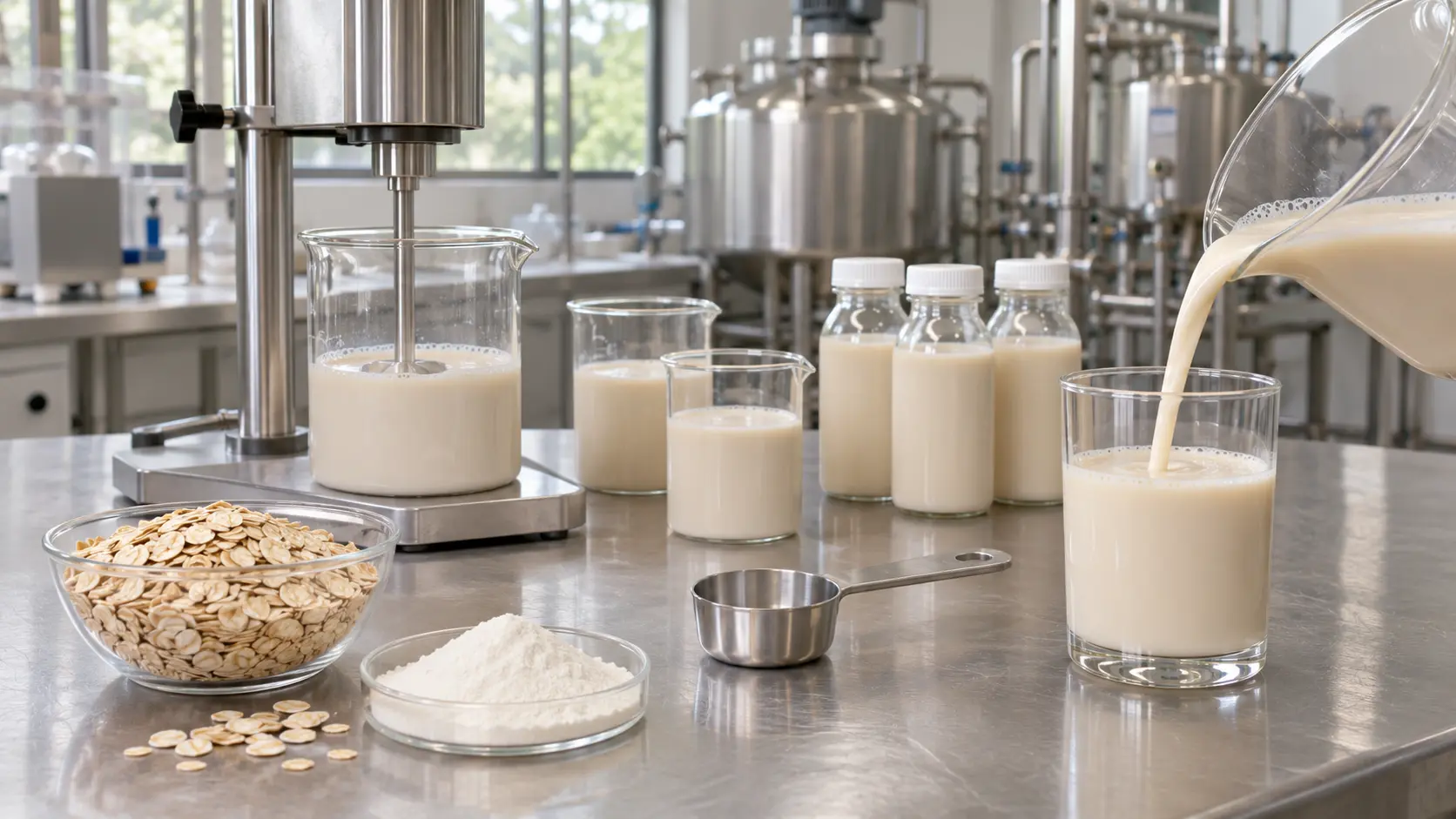
A useful trial changes a small number of variables at a time. Keep the base formulation and process consistent, then compare samples with different CMC levels or grades. Include a control without CMC so the effect is clear.
Measure more than viscosity. Check visible sediment or layering, pourability, mouthfeel, and how the beverage performs after processing and storage. For products intended for coffee, include a coffee-use test; for other beverages, assess them in the way consumers will use them.
There is no universal sodium CMC dosage for oat milk. One recent study tested specific concentrations in a particular blended beverage, but its results do not establish a general rate for commercial oat milk. Treat published values as formulation-specific examples, then optimize against your own ingredients, equipment, and target texture.
Choosing Food-Grade Sodium CMC
Selecting a suitable grade starts with the product target. Share the beverage base, desired viscosity, processing conditions, and storage requirements when discussing options with a manufacturer. Confirm that the selected grade meets the food and labeling requirements for the market where the beverage will be sold.
MIKEM manufactures food-grade sodium CMC for applications that include thickening, water retention, and suspension. Explore MIKEM’s sodium CMC or contact the team to discuss your formulation needs.
Frequently Asked Questions
Does sodium CMC prevent separation in oat milk?
It can support suspension by increasing the viscosity of the liquid phase, which may slow particle movement. It cannot guarantee that a beverage will remain stable by itself; the oat base, oil phase, processing, and storage conditions also matter.
Does CMC make oat milk thicker?
Yes, CMC can increase viscosity. The amount of thickening depends on the grade, concentration, hydration, and other ingredients in the formula.
Is CMC an emulsifier?
CMC is commonly used as a thickener and stabilizer. If the beverage contains oil, developers should also evaluate how the oil is dispersed and whether the formulation needs a separate emulsification strategy.
Is there a standard dosage for CMC in oat milk?
No single dosage applies to every formula. The appropriate level should be determined through trials using the specific oat base, process, and desired mouthfeel.
A Formulation-Specific Approach
Sodium CMC in oat milk can help developers tune suspension, pourability, and mouthfeel. Its performance depends on how it interacts with the oat base and the rest of the production process. Testing CMC in the finished formulation, rather than relying on a general dosage or a single viscosity target, gives beverage manufacturers a clearer path to a consistent product.