Die richtige Konsistenz von Zahnpasta zu erzielen, erfordert mehr Aufwand, als es zunächst scheinen mag. Die Paste muss ihre Form auf der Zahnbürste halten, sich beim Putzen angenehm verteilen und sich ohne zu großen Druck aus der Tube drücken lassen. Außerdem muss sie ihr Aussehen und ihre Textur über die gesamte Haltbarkeitsdauer bewahren. Ein Produkt, das zu dünnflüssig wird, sich während der Lagerung trennt oder sich im Mund ungleichmäßig anfühlt, kann für Hersteller schnell zum Problem werden.
Die Herausforderung ergibt sich aus der Anzahl der beteiligten Inhaltsstoffe. Konventionelle Zahnpastaformulierungen enthalten eine beträchtliche Menge fester Materialien, insbesondere Abrasivstoffe, sowie Feuchthaltemittel, Tenside, Süßstoffe, Wasser und andere funktionale Additive. Um diese Komponenten gleichmäßig verteilt zu halten und gleichzeitig die richtigen Fließeigenschaften zu gewährleisten, ist eine sorgfältig ausbalancierte Formulierung erforderlich.
Natrium-CMC In Zahnpasta hilft Herstellern, dieses Gleichgewicht zu erreichen. Natriumcarboxymethylcellulose (Natrium-CMC) wirkt als Verdickungsmittel, Bindemittel und Rheologiemodifikator. Es bildet Struktur innerhalb der Paste, unterstützt die Suspension unlöslicher Partikel und trägt zur Kontrolle der Produktkonsistenz bei.
Die Auswahl der richtigen Qualität erfordert jedoch mehr als den Vergleich von Viskositätswerten. Hydratationsverhalten, Abrasivstoffkompatibilität und Verarbeitungsbedingungen können alle die Endleistung beeinflussen. Eine Qualität, die in einer Zahnpastaformulierung gut funktioniert, kann sich in einer anderen ganz anders verhalten.
Das Verständnis dieser Unterschiede erleichtert die Entwicklung einer Zahnpasta, die während der Herstellung, Lagerung und täglichen Anwendung gleichbleibend performt.
MIKEM ist ein globaler Hersteller von Spezialchemikalien, der Natriumcarboxymethylcellulose für Zahnpasta und andere Körperpflegeanwendungen anbietet, mit Fokus auf gleichbleibende Produktqualität und Formulierungsleistung.
Was ist Natrium-CMC und wie wirkt es in Zahnpasta?
Natriumcarboxymethylcellulose, allgemein bekannt als Natrium-CMC oder CMC, ist ein wasserlösliches Cellulosederivat, das durch Einführung von Carboxymethylgruppen in die Cellulosestruktur hergestellt wird.
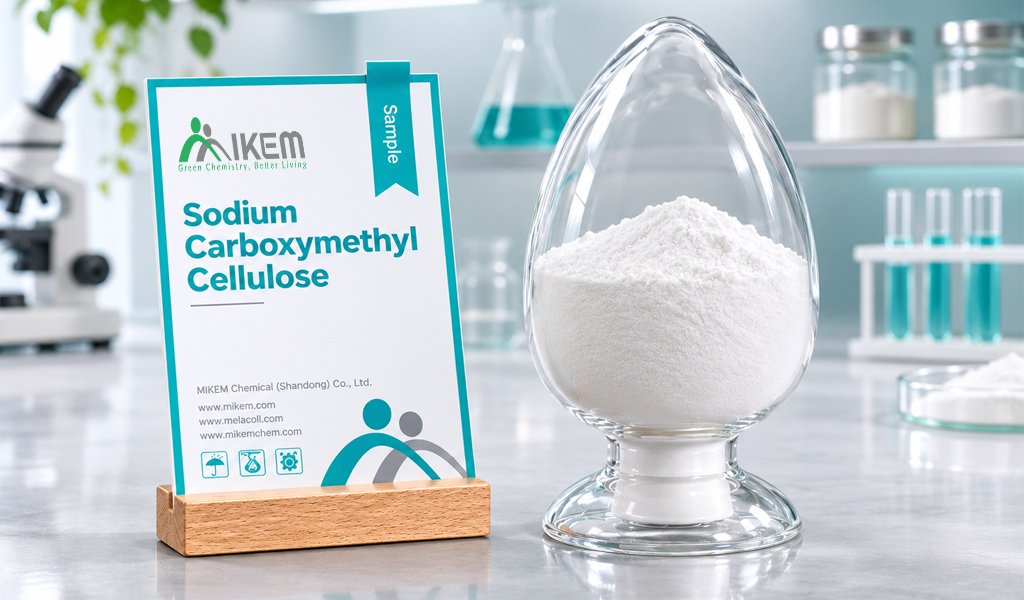
Das Material wird im Allgemeinen als weißes oder cremeweißes Pulver geliefert. Nach ordnungsgemäßer Dispergierung und Hydratation bildet es eine viskose Lösung, die das Fließverhalten der umgebenden flüssigen Phase verändert.
In der Zahnpastaherstellung dient CMC hauptsächlich als Verdickungsmittel und Bindemittel. Es hilft, die erforderliche Struktur aufzubauen, um unlösliche Inhaltsstoffe wie hydratisierte Kieselsäure und Calciumcarbonat in der gesamten Paste verteilt zu halten.
Mehrere Materialeigenschaften beeinflussen seine Leistung:
- Viskositätsgrad: Bestimmt den Verdickungsbeitrag unter festgelegten Testbedingungen.
- Substitutionsgrad (DS): Beeinflusst Löslichkeit, Hydratation und Wechselwirkungen mit anderen Formulierungsinhaltsstoffen.
- Molekulare Eigenschaften: Beeinflussen das viskositätsbildende Verhalten des Polymers.
- Partikelgröße: Beeinflusst die Pulverdispergierung und Hydratation während der Verarbeitung.
- Konzentration: Bestimmt den Beitrag von CMC zur Gesamtstruktur der Formulierung.
Diese Eigenschaften müssen zusammen betrachtet werden. Die Auswahl eines CMC-Produkts allein anhand der Viskosität führt nicht unbedingt zu den besten Ergebnissen in einer fertigen Zahnpasta.
Wie Natrium-CMC die Formulierungsleistung von Zahnpasta verbessert
1. Kontrolle von Viskosität und rheologischem Verhalten
Eine Zahnpasta muss sich je nach Situation unterschiedlich verhalten. In der Tube sollte sie stabil bleiben und nicht langsam fließen oder sich trennen. Bei Druckanwendung muss sie gleichmäßig fließen. Auf einer Zahnbürste platziert, sollte sie ihre Form halten und sich nicht unkontrolliert verteilen.
Natrium-CMC hilft, dieses Gleichgewicht herzustellen, indem es die Viskosität der kontinuierlichen Phase erhöht und zur gesamten rheologischen Struktur der Paste beiträgt.
Hydratisierte CMC-Lösungen zeigen im Allgemeinen pseudoplastisches bzw. scherverdünnendes Verhalten. Vereinfacht ausgedrückt nimmt ihre scheinbare Viskosität mit steigender Scherrate ab. Diese Eigenschaft kann in der Zahnpastaproduktion nützlich sein, da das Material während Mischen, Pumpen, Dosieren und Zähneputzen unterschiedlichen mechanischen Belastungen ausgesetzt ist.
Die Fließgrenze ist ein weiterer wichtiger Aspekt. Sie beschreibt die Spannung, die erforderlich ist, um das Fließen eines Materials einzuleiten. In Zahnpasta hilft ein geeignetes Fließgrenzenverhalten der Paste, ihre Form zu halten, wenn sie ungestört bleibt.
Natürlich ist CMC nur ein Teil des Systems. Abrasivstoffbeladung, Feuchthaltemittel, andere Polymere und Verarbeitungsbedingungen beeinflussen ebenfalls das endgültige rheologische Profil. Das Ziel ist es, eine Paste zu entwickeln, die während der Lagerung ausreichend strukturiert bleibt, ohne dass sie schwer zu verarbeiten oder zu dosieren wird.
2. Unterstützung der Suspension von Abrasivstoffpartikeln
Abrasivstoffe sind für viele Zahnpastaformulierungen unerlässlich. Hydratisierte Kieselsäure und Calciumcarbonat beispielsweise werden häufig verwendet, um Oberflächenablagerungen beim Zähneputzen zu entfernen.
Keines der beiden Materialien löst sich in der flüssigen Phase. Beide bleiben als feste Partikel in der Paste suspendiert. Ohne ausreichende strukturelle Unterstützung können sich diese Partikel allmählich durch die Formulierung bewegen, was potenziell zu einer ungleichmäßigen Verteilung oder sichtbaren Trennung führen kann.
Natrium-CMC hilft, diese Bewegung zu begrenzen, indem es die Viskosität der kontinuierlichen Phase erhöht und zur Suspensionsstruktur beiträgt. Dies ermöglicht es der Formulierung, während der Lagerung ein gleichmäßigeres Erscheinungsbild zu bewahren.
Die Anforderungen sind nicht unbedingt für jedes Abrasivstoffsystem gleich. Partikelgröße, Dichte, Konzentration und Oberflächeneigenschaften beeinflussen alle das Suspensionsverhalten. Zahnpasta auf Calciumcarbonatbasis kann beispielsweise andere Formulierungsanpassungen erfordern als Zahnpasta auf Basis hydratisierter Kieselsäure, da die beiden Materialien unterschiedlich mit Wasser und anderen Inhaltsstoffen interagieren.
Mehr CMC hinzuzufügen ist nicht immer die Lösung. Übermäßige Verdickung kann das Mischen erschweren und die Dosierbarkeit beeinträchtigen. Hersteller müssen eine Konzentration finden, die ausreichende Suspension bietet, ohne die Handhabungseigenschaften des Produkts zu beeinträchtigen.
3. Verbesserung von Textur und Konsistenz
Verbraucher bemerken die Textur von Zahnpasta, sobald sie mit dem Putzen beginnen. Ein Produkt, das sich körnig, ungleichmäßig oder übermäßig klebrig anfühlt, kann ein unangenehmes Erlebnis verursachen, selbst wenn seine grundlegende Reinigungsleistung zufriedenstellend ist.
CMC trägt zu einer gleichmäßigeren Textur bei, indem es hilft, die Struktur der Paste zu erhalten und die Verteilung suspendierter Inhaltsstoffe zu unterstützen. Eine ordnungsgemäße Hydratation ist besonders wichtig. Schlecht hydratisiertes CMC kann lokale Viskositätsunterschiede hinterlassen, die die Gleichmäßigkeit des Endprodukts beeinträchtigen können.
Die Wahl des Verdickungsmittels allein bestimmt nicht das Mundgefühl. Abrasivstoffpartikelgröße, Feuchthaltemittelauswahl und die Balance anderer Inhaltsstoffe spielen ebenfalls wichtige Rollen.
Beispielsweise kann eine Zahnpasta mit hoher Abrasivstoffkonzentration ein anderes rheologisches Profil benötigen als eine transparente Gel-Zahnpasta. Hersteller sollten die fertige Formulierung durch physikalische und sensorische Tests bewerten, anstatt anzunehmen, dass eine Erhöhung der CMC-Konzentration automatisch ein glatteres Produkt erzeugt.
4. Beitrag zur Aufrechterhaltung der Stabilität während der Lagerung
Zahnpasta sollte vom Tag der Auslieferung bis zum Ende ihrer vorgesehenen Haltbarkeitsdauer gleichbleibend aussehen und performen. Veränderungen der Konsistenz, Flüssigkeitstrennung oder ungleichmäßige Verteilung fester Inhaltsstoffe können sowohl das Produkterscheinungsbild als auch die Verbraucherakzeptanz beeinträchtigen.
Durch die Erhöhung der Viskosität der kontinuierlichen Phase hilft Natrium-CMC, die Struktur der Paste zu erhalten und die Tendenz suspendierter Partikel zu verringern, sich durch die Formulierung zu bewegen.
Sein Beitrag zur Stabilität hängt von der gewählten Qualität und den Bedingungen ab, unter denen die Zahnpasta hergestellt und gelagert wird. Temperaturschwankungen, pH-Wert, Ionengehalt, Wasser verfügbarkeit und Wechselwirkungen zwischen Inhaltsstoffen können alle das Ergebnis beeinflussen. Verpackungsbedingungen müssen ebenfalls berücksichtigt werden.
Hersteller sollten CMC daher in der tatsächlichen Zahnpastaformulierung testen, anstatt sich ausschließlich auf Labormessungen einer einfachen wässrigen Lösung zu verlassen. Beschleunigte Stabilitätstests und Echtzeit-Lagerungsstudien bieten ein aussagekräftigeres Bild davon, wie sich das fertige Produkt im Laufe der Zeit verhält.
Wie Natrium-CMC mit verschiedenen Zahnpastainhaltsstoffen interagiert
Die Kompatibilität mit anderen Rohstoffen ist ein wichtiger Teil der Auswahl von CMC in Zahnpastaqualität. Ein Produkt, das in einer einfachen wässrigen Lösung gut funktioniert, kann sich anders verhalten, sobald es in eine Formulierung mit großen Mengen an Abrasivstoffen, Feuchthaltemitteln und gelösten Inhaltsstoffen eingebracht wird.
Zahnpasta auf Calciumcarbonatbasis
Calcium carbonate is widely used as an abrasive in conventional toothpaste. Its presence creates a mineral-rich environment in which calcium ions and particle surface characteristics may influence the behavior of cellulose-based thickeners.
Dissolved calcium ions can interact with the carboxylate groups in CMC. Depending on their concentration and the overall formulation conditions, these interactions may affect hydration and viscosity development.
For this reason, CMC should be evaluated alongside the actual calcium carbonate grade intended for production. Measurements taken in pure water alone may not accurately represent its performance in the finished toothpaste.
Hydrated Silica-Based Toothpaste
Hydrated silica is another common toothpaste abrasive, particularly in formulations developed around specific cleaning and texture requirements.
Its particle surface properties and interaction with the surrounding liquid phase differ from those of calcium carbonate. As a result, the suspension and thickening requirements may also vary.
When developing a silica-based formulation, manufacturers should consider the silica grade, abrasive concentration and desired consistency before deciding on a suitable CMC product.
Humectants and Surfactants
Humectants such as sorbitol and glycerin help retain moisture in toothpaste and contribute to its overall texture. They also change the composition of the aqueous phase, which can influence CMC hydration and viscosity development.
Surfactants, including sodium lauryl sulfate (SLS) in some formulations, are used to support foaming and cleaning performance. Their presence should also be considered when evaluating the behavior of CMC in the complete formulation.
These ingredients do not work independently. Their combined effects determine how the toothpaste behaves during production and use, making full-formulation testing an important part of raw material selection.

How to Select the Right Toothpaste Grade CMC
Comparing viscosity figures is a useful starting point, but it is not enough to identify the most suitable CMC for toothpaste. Manufacturers should look at several technical properties and determine how each grade performs in their actual formulation.
Viscosity Grade
Viscosity is usually the first specification considered when comparing CMC products.
Higher-viscosity grades generally produce a greater increase in viscosity at the same concentration under comparable testing conditions. However, a higher value does not automatically mean better performance.
An excessively strong thickening effect may increase mixing resistance, complicate pumping and make the finished toothpaste difficult to dispense. At the other end of the scale, insufficient viscosity may leave the paste without the structure needed to maintain its consistency.
When comparing suppliers, make sure the reported viscosity values are measured using the same solution concentration, temperature and testing method. Otherwise, the figures may not provide a meaningful basis for comparison.
Degree of Substitution
The degree of substitution (DS) describes the average number of hydroxyl groups in the cellulose structure that have been replaced by carboxymethyl groups.
DS influences the solubility, hydration behavior and interactions of Sodium CMC with other ingredients. It should therefore be considered alongside viscosity and formulation compatibility.
A particular DS value does not guarantee better performance in every toothpaste. Its practical significance becomes clearer when the material is tested in the intended formulation.
Purity and Quality Specifications
Since toothpaste is an oral care product, raw material quality and supporting documentation deserve particular attention.
Manufacturers should review specifications such as:
- Viscosity and testing conditions
- Degree of substitution
- Moisture content
- pH
- Purity and applicable impurity limits
- Particle size and appearance
- Relevant microbiological specifications
- Batch-to-batch consistency
Documentation should match the intended application and comply with the requirements of the target market.
A reliable supplier should be able to provide clear technical specifications and quality documents, allowing customers to assess whether a particular grade meets their requirements before moving into production.
Compatibility with the Existing Formulation
The most suitable CMC grade is the one that performs reliably in the manufacturer’s actual production system.
Before making a purchasing decision, consider the abrasive type, humectant combination, surfactant system, desired texture and available production equipment.
Testing several suitable grades in the same base formulation will usually provide a more useful comparison than choosing a product solely on the basis of its published viscosity.
Processing Considerations for Sodium CMC in Toothpaste Manufacturing
Even a well-selected CMC grade can produce inconsistent results if the processing conditions are not properly controlled. Poor powder dispersion, incomplete hydration and inconsistent mixing may lead to uneven viscosity or visible lumps, affecting both production efficiency and finished product quality.
Powder Dispersion
CMC powder needs to be distributed evenly before hydration can proceed properly. When powder particles come into contact with water too quickly in localized areas, their outer surfaces may hydrate and form a gel-like layer. This layer slows water penetration into the remaining powder.
The result is often the formation of small gel-like lumps, commonly referred to as fish eyes.
To reduce this problem, manufacturers should control the powder addition rate and mixing conditions. Depending on the formulation and production equipment, pre-dispersion or other controlled addition methods may also be useful.
Hydration Control
After dispersion, CMC needs sufficient time and suitable conditions to hydrate fully.
Temperature, concentration, water availability, dissolved salts and other formulation ingredients can all affect the hydration process. Adding CMC directly to a complex formulation may produce a different result from hydrating it in a simpler aqueous phase first.
The appropriate approach depends on the formulation and equipment, so process trials are important before establishing a standard production procedure.
Mixing Sequence
The order in which ingredients are added can influence CMC hydration and viscosity development.
For example, manufacturers may need to determine whether CMC should be dispersed and hydrated before introducing certain mineral ingredients or other formulation components.
There is no single mixing sequence that works for every toothpaste. The best procedure depends on the CMC grade, ingredient composition and production equipment.
Final Viscosity Adjustment
Viscosity should be evaluated after the formulation has reached an appropriate level of hydration and processing stability.
An initial mixture measurement may not accurately represent the finished product. Manufacturers should also check flow behavior, dispensing characteristics and appearance after production.
Keeping mixing procedures and processing conditions consistent from batch to batch is just as important as selecting the right raw material.
Common Formulation Problems and How to Address Them
Even carefully developed toothpaste formulations can encounter problems during manufacturing or storage. Before changing the CMC concentration or switching grades, it is worth checking the processing conditions and the interactions between ingredients.
Problem 1: Toothpaste Is Too Thin
Insufficient viscosity may result from an unsuitable CMC grade, insufficient concentration or incomplete hydration. Other formulation ingredients can also affect the thickening performance.
Start by reviewing the hydration process and checking whether the selected CMC specification matches the desired rheological properties. Increasing the concentration may be an option, but it should be tested rather than assumed to be the correct solution.
Problem 2: Liquid Separation During Storage
Separation may indicate that the paste structure is not sufficient to maintain the distribution of solid ingredients. CMC can improve suspension, but the abrasive system, ionic content and overall formulation balance also need to be examined.
Simply adding more thickener may not resolve an underlying compatibility problem.
Problem 3: Excessive Thickness and Poor Dispensing
A toothpaste that is too thick may be difficult to pump, fill or squeeze from its tube. An unsuitable CMC grade, excessive concentration or interactions with other ingredients may contribute to the problem.
Reviewing the CMC level and the complete rheological profile is a better approach than aiming for maximum viscosity.
Problem 4: Uneven Texture or Visible Lumps
Poor powder dispersion and incomplete hydration are common causes of uneven texture. The mixing conditions, powder addition rate and presence of other ingredients should be reviewed.
A suitable CMC grade, combined with consistent dispersion and hydration procedures, can help reduce these problems and improve batch uniformity.

Warum MIKEM als Ihren Natrium-CMC-Hersteller wählen?
For toothpaste manufacturers, choosing a raw material supplier is about more than finding a product that meets a specification. Consistent quality, reliable production and the ability to maintain supply over time all matter, particularly when a raw material is already part of an established formulation.
MIKEM is a manufacturer, not simply an intermediary in the chemical supply chain. Its business focuses on manufacturing capabilities, product quality management and flexible supply. This manufacturing-oriented approach provides customers with a more direct basis for discussing product requirements and long-term cooperation.
Manufacturing-Focused Product Supply
As a manufacturer, MIKEM focuses on product specifications and production quality. For customers, this provides a clearer starting point for discussing raw material requirements, evaluating product grades and establishing long-term supply arrangements.
Quality Management and Batch Consistency
Changes in raw material specifications can affect viscosity, hydration and processing behavior. This is particularly important for toothpaste manufacturers who need to maintain established formulations across repeated production runs.
MIKEM emphasizes quality management and controlled product specifications to support consistent raw material performance and more predictable purchasing decisions.
Product Selection and Technical Communication
Not every toothpaste requires the same CMC characteristics. A silica-based formulation may have different requirements from a calcium carbonate-based system, while differences in processing equipment can also influence grade selection.
MIKEM works with customers to understand their viscosity requirements, formulation characteristics and processing conditions before discussing suitable grades for laboratory evaluation.
Flexible Supply and Packaging
Production requirements vary from one customer to another. Some manufacturers need regular bulk supply, while others have different packaging preferences, purchasing volumes or delivery arrangements.
MIKEM offers flexible supply and packaging options to accommodate different customer requirements and support long-term cooperation.
For companies developing conventional toothpaste, gel toothpaste or other oral care products, choosing the right Sodium CMC is an important part of maintaining formulation consistency. Working with a manufacturer that understands product specifications and supply requirements can make that process more straightforward.
Looking for a reliable Sodium CMC manufacturer for toothpaste applications? MIKEM kontaktieren to discuss your viscosity requirements, product specifications and supply needs.
Häufig gestellte Fragen
1. What does Sodium CMC do in toothpaste?
Sodium CMC primarily functions as a thickener, binder and rheology modifier. It helps control paste consistency, supports abrasive particle suspension and contributes to the physical stability of toothpaste.
2. Why is CMC used as a toothpaste thickener?
CMC forms a viscous solution when properly hydrated. It helps create the structure needed to maintain the distribution of insoluble ingredients while providing suitable flow and dispensing properties.
3. Can Sodium CMC prevent toothpaste separation?
Sodium CMC can help reduce the movement of solid particles by increasing the viscosity of the continuous phase and contributing to the paste structure. However, separation also depends on ingredient compatibility, abrasive characteristics, processing and storage conditions.
4. What viscosity grade of CMC is suitable for toothpaste?
There is no single viscosity grade suitable for every toothpaste formulation. Selection depends on the abrasive system, desired consistency, manufacturing process and finished product requirements. Laboratory trials are recommended before commercial production.
5. What is the difference between toothpaste-grade CMC and food-grade CMC?
CMC grades are manufactured and specified according to their intended applications and applicable quality requirements. Even when two grades have similar viscosity values, their purity specifications, impurity limits and supporting documentation may differ.
Manufacturers should select a grade that meets the applicable requirements for their oral care products rather than assuming that all food-grade CMC is automatically suitable for toothpaste.
6. Can Sodium CMC be used in silica-based toothpaste?
Yes. Sodium CMC can be used in hydrated silica-based toothpaste formulations as a thickener and binder. The appropriate grade and concentration should be determined through compatibility testing and formulation trials.
7. How can manufacturers prevent CMC lumps during toothpaste production?
Lumps may form when CMC powder is poorly dispersed or hydrates too quickly on its outer surface. Controlled powder addition, suitable mixing conditions and an appropriate hydration procedure can help reduce this problem.
8. What should manufacturers check when purchasing Sodium CMC?
Important considerations include viscosity, degree of substitution, moisture content, pH, purity, relevant impurity specifications, particle size and batch consistency. Suppliers should also provide appropriate technical documentation to support product evaluation.