A biscuit that spreads too much during baking can come out thin, uneven and difficult to package. On the other hand, insufficient expansion may leave the product dense, hard or lacking the texture consumers expect. For commercial biscuit manufacturers, these problems are not simply matters of appearance. They can affect production efficiency, product consistency and customer acceptance.
Leavening agents play an important role in controlling how biscuits develop during baking. By generating gases such as carbon dioxide, or ammonia in the case of ammonium-based leavening, they help create the internal structure that determines biscuit thickness, porosity and bite.
However, the relationship between leavening and biscuit quality is more complicated than simply adding an ingredient to make dough expand. Some biscuits need a light, open structure, while others are expected to remain relatively thin and compact. A cracker, a hard biscuit and a sweet cookie may use different leavening systems even when they are produced with similar basic ingredients.
The challenge for manufacturers is to match the leavening system to the dough formulation and baking process. The right choice can help achieve more predictable expansion, but it must work alongside flour properties, fat content, sugar composition, moisture and oven conditions.
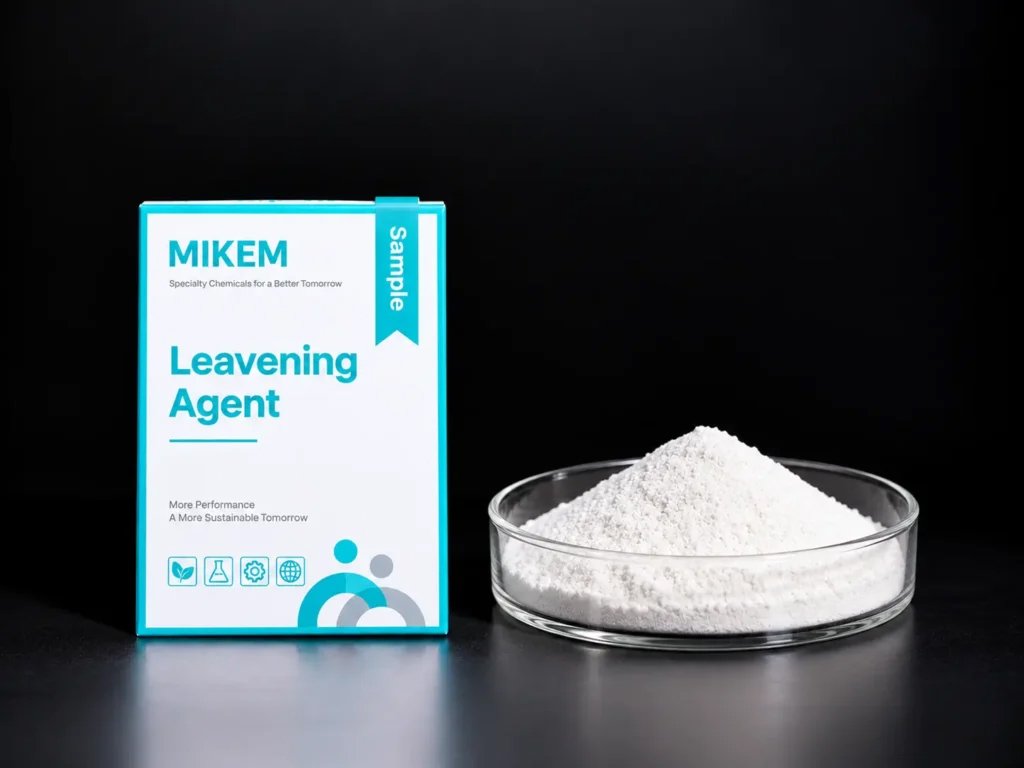
Common Leavening Agents Used in Biscuit Formulations
Chemical leavening is widely used in commercial biscuit production because it allows manufacturers to control gas generation without relying on yeast fermentation. The main ingredients include sodium bicarbonate, ammonium bicarbonate and acid components used in baking powder systems.
1. Sodium Bicarbonate
Sodium bicarbonate (NaHCO₃), commonly known as baking soda, is one of the most widely used chemical leavening ingredients in biscuits.
Its primary function is to release carbon dioxide when it reacts with an acidic ingredient in the formulation.
NaHCO₃ + HA → NaA + CO₂ + H₂O
The carbon dioxide forms gas cells within the dough. As the temperature rises, these cells expand and contribute to the biscuit’s internal structure.
There is another reaction worth considering. Sodium bicarbonate can also undergo thermal decomposition during baking:
2NaHCO₃ → Na₂CO₃ + CO₂ + H₂O
This reaction produces sodium carbonate, which is alkaline and does not evaporate during baking.
This matters because sodium bicarbonate affects more than gas generation. It also changes the pH of the dough, influencing browning reactions, surface color and flavor. A higher pH can promote browning, which may be desirable in certain biscuit formulations. However, excessive residual alkalinity can produce an unpleasant soapy or alkaline taste.
For this reason, manufacturers need to consider the relationship between sodium bicarbonate and the acidic components in the recipe. Complete neutralization is not necessarily the objective in every biscuit, since some formulations deliberately retain a certain degree of alkalinity. What matters is controlling the final pH and avoiding unwanted sensory effects.
2. Ammonium Bicarbonate
Ammonium bicarbonate (NH₄HCO₃) is particularly useful in thin, low-moisture bakery products, including certain commercial biscuits and crackers.
When heated, it decomposes into ammonia, carbon dioxide and water vapor:
NH₄HCO₃ → NH₃ + CO₂ + H₂O
Unlike sodium bicarbonate, ammonium bicarbonate does not leave a significant non-volatile alkaline salt residue after decomposition. Its gaseous products can escape during baking, making it suitable for products with a relatively large surface area and low moisture content.
There is, however, an important limitation. Ammonia must be able to leave the product during baking. If the biscuit is too thick, contains too much moisture or is baked under unsuitable conditions, some ammonia may remain and affect the finished product’s smell and taste.
This is why ammonium bicarbonate is generally more suitable for thin and dry biscuits than for thick, soft-centered bakery products. Its dosage and baking conditions should be evaluated together rather than determined by the ingredient alone.
3. Baking Powder and Leavening Acid Components
Baking powder is a formulated chemical leavening system that usually combines sodium bicarbonate with one or more food-grade acid components. A carrier, commonly starch, may also be included to help maintain the physical stability and distribution of the ingredients.
The acid component determines how the reaction develops after hydration and during heating. Different acids release carbon dioxide at different rates, giving manufacturers a way to match gas generation to their production process.
Common leavening acid components include:
| Acid Component |
General Reaction Characteristics |
Formulierungsüberlegungen |
| Monocalcium Phosphate (MCP) |
Generally fast-acting |
Useful when rapid gas release is required |
| Sodium Acid Pyrophosphate (SAPP) |
Reaction rate varies by grade |
Different grades provide different gas-release profiles |
| Sodium Aluminum Phosphate (SALP) |
Generally used in slower-reacting systems |
Can support gas release later in the baking process |
| Dicalcium Phosphate (DCP) |
Relatively slow reaction |
May be considered in formulations requiring delayed gas release |
These differences are important when designing commercial biscuit formulations.
A fast-reacting acid may release a substantial amount of carbon dioxide during mixing, while a slower-reacting component can provide more gas during heating. Double-acting baking powder systems use a combination of reaction behaviors to release gas in stages.
The objective is to avoid losing too much gas before the dough reaches the oven while ensuring that sufficient expansion takes place during baking.
The appropriate acid combination depends on the product, processing time, moisture level and applicable food regulations.
How Leavening Agents Affect Biscuit Spread and Thickness
Biscuit spread is one of the most important physical characteristics in commercial production. It determines the final diameter, thickness and shape of the product, all of which influence packaging and production consistency.
Leavening agents affect expansion, but they do not independently determine how far a biscuit spreads.
During the early stages of baking, the dough begins to soften. Fat melts, sugars dissolve and the viscosity of the dough changes. At the same time, carbon dioxide and water vapor expand inside the dough, creating pressure within existing gas cells.
The dough continues to flow until its structure becomes firm enough to hold its shape. The balance between dough flow, gas expansion and structure setting determines the final dimensions of the biscuit.
Hier kommen dough rheology becomes important.
Dough viscosity and its response to temperature influence how quickly a biscuit spreads before its structure sets. Several formulation factors need to be considered:
- Fat content and melting behavior: Fat affects dough consistency and lubrication. Changes in fat content can significantly influence spread and the final biscuit structure.
- Sugar composition: Sugar affects water availability, dough viscosity and the temperature at which the structure develops.
- Flour properties: Protein content, starch characteristics and water absorption influence dough handling and structural development.
- Water content: Water affects ingredient hydration, dough consistency and the movement of the dough during baking.
- Dough temperature: Temperature changes the behavior of fat and influences the rate at which the dough softens.
- Leavening system: Gas generation, reaction timing and pH changes influence expansion and the development of the internal structure.
For manufacturers experiencing inconsistent biscuit dimensions, increasing or reducing the leavening dosage may not be enough. The dough formulation and baking profile should be evaluated together.
Achieving the Right Porosity and Crispness
A good biscuit does not always need a large internal volume. The ideal structure depends on the product itself.
Crackers may require a relatively open structure with evenly distributed pores. Some sweet biscuits benefit from a more compact texture, while other products need a lighter and more delicate bite.
Leavening agents contribute to this structure by generating gas inside the dough. As the temperature rises, the gas cells expand. Their size, distribution and ability to remain stable during baking all influence the finished product.
If gas generation occurs too quickly, or if the dough cannot retain the expanding gas, the biscuit may develop large cavities, uneven pores or surface defects. If gas generation is insufficient, the finished product may be too dense.
However, internal porosity is only one part of biscuit crispness.
Moisture content and water activity are equally important. These two measurements are related but not interchangeable. Moisture content describes how much water is present in the product, while water activity (Aw) indicates how available that water is within the food system.
During storage, biscuits can absorb moisture from the surrounding environment. Moisture can also migrate between components in products such as cream-filled or coated biscuits. As water activity increases, the product may lose its crisp texture and become softer.
Manufacturers should therefore pay attention to three aspects:
- Gas generation: The leavening system should produce enough gas to create the intended internal structure.
- Structure setting: The dough needs to develop sufficient strength to retain its shape as gas cells expand.
- Moisture management: Baking, cooling, packaging and storage conditions should help maintain the desired moisture level and crispness.
A well-designed leavening system can improve the initial biscuit structure, but it cannot compensate for poor drying or inadequate moisture-barrier packaging.

Factors That Influence Leavening Performance in Biscuit Production
Even when manufacturers use the same leavening ingredient, production results can differ. The following factors deserve particular attention.
1. Acid-to-Alkali Balance
In formulations containing sodium bicarbonate and acid components, their proportions influence carbon dioxide generation and final dough pH.
Too little acid may leave excessive alkalinity, while an unsuitable reaction balance can result in insufficient or poorly timed gas release.
The acid component should be selected according to the required reaction profile, product characteristics and applicable food regulations.
2. Dough Moisture and Hydration
Water is necessary for the dissolution and reaction of many chemical leavening ingredients. It also influences the physical properties of the dough.
Insufficient moisture may limit hydration and affect the reaction between ingredients. Excessive moisture, meanwhile, can make the dough too soft and increase spreading during baking.
The appropriate level depends on the flour, sugar, fat, processing method and finished biscuit specifications.
3. Mixing and Ingredient Distribution
Uniform mixing is essential for consistent leavening performance.
If sodium bicarbonate or acid components are unevenly distributed, different parts of the dough may generate different amounts of gas. This can produce variations in thickness, internal porosity and surface appearance.
Mixing time, ingredient particle size and dough temperature should therefore be controlled carefully. The goal is to achieve even distribution without unnecessarily changing the dough’s physical properties.
4. Baking Temperature and Time
The oven determines how quickly the leavening system reacts and how the biscuit structure develops.
A temperature profile that is too aggressive may cause rapid expansion before the structure has stabilized. Insufficient baking, on the other hand, can leave excessive moisture in the finished product.
Manufacturers should evaluate the leavening system under representative production conditions, taking oven temperature, belt speed and baking time into account.
Choosing the Right Leavening System for Different Biscuits
Different biscuit products have different requirements for expansion, thickness, internal structure and final moisture content.
| Biscuit Type |
Main Leavening Considerations |
| Crackers |
Controlled gas release, uniform porosity and a dry, crisp structure |
| Sweet Biscuits |
Balanced expansion, dough spread, browning and flavor |
| Thin Cookies |
Controlled spreading and suitable gas release |
| Hard Biscuits |
Consistent dimensions, moderate expansion and a firm structure |
| Sandwich Biscuits |
Uniform thickness, stable structure and moisture control after filling |
For thin, low-moisture products, ammonium bicarbonate may be considered because its gaseous decomposition products can escape during baking. Sodium bicarbonate and suitable acid components are also used in different biscuit formulations to manage carbon dioxide release and pH.
There is no universal leavening system for an entire product category. Two manufacturers producing similar biscuits may still require different ingredient combinations because their flour blends, fat levels, dough moisture and production equipment are not identical.
The final decision should be based on formulation trials and actual production performance.
The Role of Other Functional Ingredients in Biscuit Formulation
Leavening agents generate gas, but other functional ingredients influence how the dough behaves and how the finished product develops.
This becomes particularly important in gluten-free formulations, where the absence of a conventional gluten network changes the way dough or batter retains gas.
Hydrocolloids such as Hydroxypropyl Methylcellulose (HPMC) are used in certain gluten-free bakery formulations to modify viscosity and support gas-cell stability during baking. HPMC also has heat-responsive gelation properties that can contribute to structure development.
MIKEM has previously discussed this application in its article, HPMC in glutenfreiem Brot: Unterstützung von Laibvolumen, Krümelstruktur und Feuchtigkeitsretention.
Bread and biscuits are different food systems, so their formulation requirements should not be treated as interchangeable. Nevertheless, the same principle applies: the performance of a functional ingredient depends on how it interacts with the rest of the formulation.
HPMC does not replace chemical leavening. One helps modify the structure of the dough or batter, while the other generates gas. Understanding their different functions helps manufacturers make better decisions when developing specialized bakery products.
How MIKEM Supports Leavening Agent Selection
For commercial biscuit manufacturers, choosing a suitable leavening agent is only part of the process. The ingredient must also meet the required specifications, perform consistently in the formulation and remain suitable for the intended production conditions.
MIKEM offers leavening ingredients and solutions for selected bakery and flour-based food applications, including biscuits and cookies.
Rather than treating every customer requirement as identical, MIKEM focuses on evaluating product specifications and application needs. This is particularly important in biscuit production, where small differences in gas release behavior, pH and processing conditions can affect the final product.
MIKEM’s manufacturer-focused approach emphasizes several areas:
- Kontrollierte Fertigung: A manufacturing-oriented approach focused on stable production processes and consistent product characteristics.
- Consistent Quality Control: Material evaluation and quality management to support reliable product specifications and batch consistency.
- Technical Application Support: Assistance with ingredient functionality, formulation compatibility and product selection based on actual processing requirements.
- Quality Documentation: Support with relevant technical documents and product qualification requirements.
- Flexible Supply and Packaging: Cooperation with customers to understand their purchasing volumes, packaging preferences and supply requirements.
For manufacturers developing new biscuit formulations or improving existing production lines, working with a supplier that understands both ingredient specifications and application requirements can make product evaluation more efficient.
You can learn more about MIKEM Leavening Agents and discuss your product requirements with the team.
Practical Formulation Tips for Biscuit Manufacturers
Before making large-scale changes to a biscuit recipe, manufacturers should conduct controlled formulation trials. Changing several ingredients simultaneously makes it difficult to identify what actually improves or reduces product performance.
A practical starting point is to maintain the same flour, fat, sugar and water levels while testing different leavening systems or dosage levels within the supplier’s recommended range.
During testing, it is worth recording more than the appearance of the finished biscuit. The following measurements can provide a clearer picture of formulation performance:
- Spread Ratio: Compare biscuit diameter and thickness to identify changes in spreading and expansion.
- Internal Porosity: Examine pore size and distribution to assess the uniformity of the internal structure.
- Moisture Content and Water Activity: Evaluate the finished product’s moisture condition and its potential to maintain crispness during storage.
- Color Development: Monitor surface browning and identify possible pH-related changes.
- Texture: Measure hardness, crispness and breaking characteristics.
- Sensory Quality: Check for unwanted alkaline, soapy or ammonia-related notes.
Successful laboratory trials should also be repeated under realistic production conditions. Commercial ovens may differ in heat distribution, airflow and belt speed, while large-scale dough mixing can introduce variations that are not always apparent in small batches.
By keeping accurate records and changing one major formulation variable at a time, manufacturers can identify the adjustments that genuinely improve biscuit quality.

Häufig gestellte Fragen
1. What are the most commonly used leavening agents in commercial biscuits?
Sodium bicarbonate and ammonium bicarbonate are widely used in commercial biscuit formulations. Baking powder systems containing sodium bicarbonate and suitable acid components are also used. The choice depends on product thickness, moisture content, desired texture and processing conditions.
2. Why is ammonium bicarbonate used in thin biscuits?
Ammonium bicarbonate decomposes during heating, releasing ammonia, carbon dioxide and water vapor. In thin, low-moisture products, these gases can escape effectively, helping create a light and porous structure without leaving significant non-volatile solid residue.
3. Does sodium bicarbonate make biscuits spread more?
Sodium bicarbonate can influence biscuit expansion, pH and browning. Its effect on spread depends on the complete dough formulation, including fat, sugar, flour properties, hydration and baking temperature. It should not be treated as the only factor controlling biscuit diameter.
4. What is the difference between sodium bicarbonate and baking powder?
Sodium bicarbonate is an alkaline leavening ingredient that requires an acid source for controlled carbon dioxide generation. Baking powder combines sodium bicarbonate with one or more acid components, allowing gas release to be adjusted according to the formulation and processing conditions.
5. How can manufacturers improve biscuit crispness?
A suitable leavening system helps establish the desired internal structure, but crispness also depends on final moisture content, water activity, drying conditions and packaging. Moisture absorption during storage can soften biscuits even when their initial structure is satisfactory.
6. How should manufacturers determine the correct leavening agent dosage?
There is no universal dosage for all biscuit formulations. Manufacturers should consider the active ingredients, acid-to-alkali balance, flour and fat composition, dough moisture and baking conditions. Controlled trials should be conducted within the supplier’s recommended application range.
7. Why is the reaction speed of baking powder important?
The reaction speed determines when carbon dioxide is released. If too much gas is generated during mixing or before the dough enters the oven, some expansion potential may be lost. A suitable reaction profile helps match gas generation with the stages of dough expansion and structure setting.
Looking for a Reliable Leavening Agent Manufacturer?
Consistent biscuit quality depends on more than a good recipe. The ingredients must meet the required specifications, work properly within the formulation and deliver predictable performance under commercial production conditions.
MIKEM works with food manufacturers to evaluate leavening agent specifications, discuss application requirements and support reliable product supply.
Whether you are developing a new biscuit formulation, adjusting an existing leavening system or looking for a dependable manufacturing partner, MIKEM can discuss your requirements and help evaluate suitable solutions.
Looking for a reliable leavening agent manufacturer for your biscuit production? MIKEM kontaktieren to discuss your formulation, technical specifications and supply requirements.